May 5-6 (Mon, Tues)
We left San Diego at 8:30 in the evening – a 10-hour flight to London and then a 5-hour wait in London until the next flight to Budapest. It was an uneventful transit except for the fire alarm and evacuation of the departure lounge at Heathrow. We finally got on the plane and the captain announced we had an extra passenger, which airlines take very seriously these days. The crew sorted things out and we were finally on our way.
We arrived in Budapest at midnight. Thomas Lantos, who rented us the apartment in Budapest, met us at the airport. It was a quiet ride to the heart of the city. Thomas was very political. He said, "Your President is so stupid.“ We didn’t argue with him.
We loved the 100-year old apartment with its big doors, 2 bedrooms, huge bath and living room and located on a quiet pedestrian walkway (Vaci Utca). It made our stay in Budapest very special. The only drawback is that the dollar has taken a nosedive – much to our dismay. We unpacked and got to bed at 2 am.
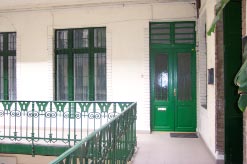
Our Apartment in Budapest |
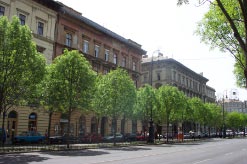
Andrassy Street |
May 7 (Wed) - Budapest
I woke up at 11 am. Bill couldn‘t sleep and was up at 8 checking out the neighborhood. He found the Great Market Hall (Nagycsamok) just down the block and got some food for our breakfast. The Market was built in the late 19th Century and still looks grand.
After I woke up, we had a little breakfast – but the apartment has no coffee maker. We hit the streets for a cappuccino fix and then we were ready to explore Budapest.
Our first stop was the Tourist Office to get a Budapest Card (discount to museums and unlimited free travel around the city). Budapest has a wonderful mass transit system.
First we saw the beautiful St. Stephen‘s Basilica – it was oh so medieval. Stephen was crowned the first king of Hungary on Christmas day in 1000. He must have had some good press because later he was made a saint. Inside the church and down some stairs was a little chapel called the Chapel of the Holy Right Hand. Sure enough, St. Stephen’s hand was on view in a jeweled, ornate container. The container was gorgeous, but the hand looked pitiful, all black and withered up, but not bad for 1,000 years.
Next we walked down the elegant old Andrassey Street. I love the buildings here – so ornate and gothic and I suppose Baroque. Sorry I don‘t know much about architecture – but this place is special, cooler than Paris. The buildings are taller with a lot more interesting decorations stuck on them – and the statues are so darn interesting. I guess the New Europe is as classy as the Old Europe. At 3 pm, we toured the classic old Italian-style renaissance Opera House (completed in 1884). Hayden was the conductor there at one time and Mozart was a student. We had to wear protective booties to walk around the beautiful marble floors. If you come for a real opera, booties are not required.
Our guide showed us the nooks and crannies in the terrace smoking rooms adjacent to the classy old bar – the place where lovers met during intermission. The place would knock your eyeballs out – but I can‘t prove it because NO PHOTOS! The ceilings were covered with magnificent murals (or are they frescos?) and a 3-ton chandelier that hangs in the main theatre. There was, of course, the grand central entry for rich and/or royalty.
The Opera House was built so the proper folks could attend the opera without having to run all the way to Vienna. As part of a compromise, the ruling Hapsburgs needed to elevate Budapest to the status of Vienna. An Austrian Count gave the money to build the Opera House in Budapest with the condition that the place could not be bigger than Vienna’s Opera House. In 1884, King Franz Josef and his beautiful wife Sissy (the Hapsburg top dogs) attended opening night. They were stunned by its beauty. How could Budapest have a more beautiful opera house than Vienna? (The folks in Budapest said the only stipulation was that the Opera House could not be bigger than Vienna’s Opera House, they didn‘t say it couldn‘t be better.)
A fire in Vienna’s Opera House in 1881 that killed 400 people forced the planners of the Budapest Opera House to consider fire safety, including extra exits, a 16-ton iron curtain to block the flames (raised by a hydraulic system), and elevated boxes filled with water, which operate much like our sprinkler systems today.
The place was really forward thinking – an orchestra pit that can be raised to floor level to accommodate dances, an 1884 air conditioning system (using lots of ice), and a moveable stage,
Being the cultured folks we are and learning that the prices for the opera and ballet were only 10 or 20 bucks, we bought tickets for a ballet for Tuesday evening.
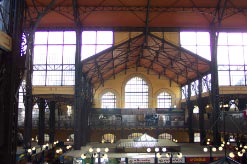
Market Hall |
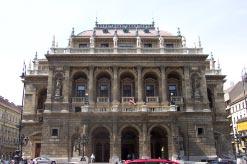
Budapest Opera House
|
Right outside the Opera House is the very first subway built anywhere in the world. It’s still in use today. We rode it several times. And right across the street from the Opera House is a wonderful old coffee house. However, the communists didn’t want a coffee house because of the free discussions that go on there, so they changed that old place into a ballet school. The ballet school didn’t work out, so now the old coffee house is scheduled to become an elegant hotel.
We left the Opera House neighborhood and headed for an outdoor café. We had a yummy lunch at a cafe called the Vian. The weather was warm and beautiful – so many sexy young Hungarian women in their skimpy summer frocks. They wear these bras with clear plastic straps. Bill is smiling a lot. Sorry I can‘t say much for the Hungarian guys and I did notice that the Hungarian women don’t age very well.
We rode the metro back to our apartment, rested, and then walked across the Independence Bridge to explore the baths left over from the Turks. We checked out a couple, but they were closing. The Galleon baths were nice, but the Ramos baths looked dirty and grungy. Everything closes very early here, probably resulting from 50 years of a repressive government.
We walked back on the Elizabeth Bridge. Budapest is magic. Parliament looks like a fairy tale building situated along the Danube. By the way, the Danube is not blue. It is greenish gray and big and flows fast – much wider than the Thames or the Seine.
We had an ice cream on our way back to the apartment, and then edited my photos. I love going digital – Bill doesn‘t frown as much at me for taking so many photos.
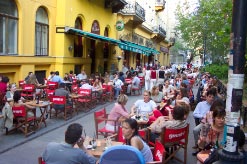 Lunch Stop Lunch Stop |
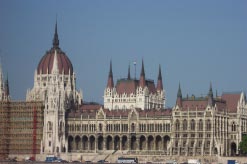
Hungarian Parilament
|
May 8 (Thurs) - Budapest
We made our coffee-less breakfast in the apartment, and then walked to the Great Market for our java jolt with the locals. However, most of the locals are downing beer at 8 in the morning.
We caught the tram at the foot of the Chain Bridge (so many bridges here). Two giant lions guard the Chain Bridge. Rumor has it that the sculptor drowned himself in the river because he forgot to give the lions any tongues.
We walked across the bridge to the Buda side and then took the funicular to the top of Castle Hill to see the Royal Palace. The funicular was built in 1870, destroyed in WW II, then rebuilt – familiar story for these here parts. There were wonderful views of the Pest side of Budapest from the hill and some cool statues. (My shutter finger was out of control.)
Several museums were housed in the palace.
The Hungarian National Gallery displayed the greatest artworks produced by Hungarian 19th century artists. I haven‘t seen much Hungarian artwork and was struck by the human faces filled with so much character. I felt as if I knew them. So many of the paintings seemed to tell a story. We spent a lot of time conjuring up stories about the paintings – such fun to draw conclusions from a few visuals.
The Museum of Contemporary Art was strange, not unlike most contemporary art museums. The large entry hall had 10 suspended video screens with nude old men and women dancing across the screens on white backdrops – all choreographed to music, only the women were fitted with dildos while the men had muffs. Need I say more?
In the Budapest History Museum, the basement was the actual gothic rooms of the Palace. The rooms were uncovered during post WW II excavations. The statues and the surroundings dated back to the 14th Century. You could just feel the ghosts of ladies, knights, monks, wenches and other medieval inhabitants.
After the palace museums, we walked the streets of Castle Hill – a wonderful quaint neighborhood. We had lunch at an arty place (Cafe Miro) in the shadow of Mattias Church. Mattias Corvinus was the most loved king. He was called the Renaissance monarch because he opened doors for the wonderful new ideas from the west. He was married twice inside that very church.
We checked out the church in Castle Hill and hit one more museum – the Museum of Military History. We were, however, museumed-out. The Military Museum was pretty much like all military museums, outlining the story of the conquered and the conqueree, the oppressor and the oppressee. However, one room was dedicated to the 1956 uprising led by Hungarian students. There were 13 days of fighting until Soviet forces crushed the rebellion. And I mean CRUSHED -- 25,000 dead, 20,000 arrested, 2,000 executed and 250,000 fled to Austria. The last Soviet forces didn’t leave until 1991, when Hungary was well on its way to capitalism. Thomas, our apartment landlord, asked us, “Where was the U.S. in 1956, the Suez Canal?”
We walked down Castle Hill past Fisherman‘s Bastion, a new-Romanesque structure built in 1905. We caught the Metro and crashed at our apartment. We went to a lovely little cafe (Cafe Soul) for excellent pasta. These places are better than Paris – get here fast before the dollar is completely shot.
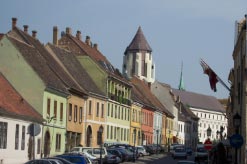
Castle Hill |
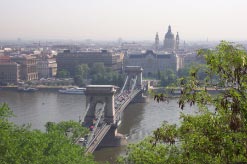
Chain Bridge |
May 9 (Fri) - Budapest
It started out as a busted day – but we wouldn‘t let fate have his way.
After our cappuccino fix at the Market, we went to the Jewish Synagogue only to discover they were closed for a special holiday. We were disappointed. We really wanted to understand what happened to the Jewish people here during WWII. Guess we’ll have to wait to get the story in Poland.
We jumped on the metro and headed to Parliament hoping for the 12-noon English-language tour. Foiled again – tickets sold out, so we would have to wait for the 2:30 tour. We had just enough time to dash over to the Hungarian National Museum – great building and well-organized displays. Each room was labeled and depicted a period – easy to follow. We learned a lot about the role of the Guilds in the development of townships. (For example, how guilds divided into other guilds like toolmaker to ironworks and locksmiths into clock makers. One observation about the museums here – each room has a couple of Nazi gals (a few guys, too) whose job (and joy in life, I’m sure) is to not let you make one false move. I went to look out a window. Don‘t know what she said, but I feared for my life. No backpacks are allowed and the fee to use a camera is as much as a person and that doesn‘t mean you can take pictures of everything. 50 years of a repressive government does something to folks, I suppose.
After a quick lunch, we were back at Parliament for the 2:30 tour and more Nazi treatment. Stand here – don‘t touch, don‘t look, don‘t breath. All these rules provoke the rebel in me.
In any case, Parliament was fabulous and well worth the trouble. The highlight was the actual crown of St. Stephen, first king of Hungary (1000 AD). There is some debate if it is the actual crown. The bottom part is Greek, the top Latin and the cross on top of the crown is bent at a 66-degree angle. Speculation is that the cross was bent from hiding the crown during the occupation of other countries. Another conjecture is that the 66 degrees represents the angle of the earth‘s orbit to the sun.
After Parliament, we went back to the apartment for a little wine and cheese and prepared for our night at the Opera House. We loved our box seats with red velvet chairs and couch and mirror to adjust our attire (my $4 pants from Target). I felt like a princess, watching the ballet, Romeo and Juliet. It was wonderful – 40 or more dancers, a huge orchestra and no language issue (no dialogue). After the performance, we walked to an elegant cafe where proper theatre people go. (Bill voted this place the classiest cafe.) It was a warm, balmy evening. We got a table by the large open window. Food was so tasty – God I love to travel.
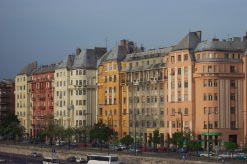
Apartments along the Danube |
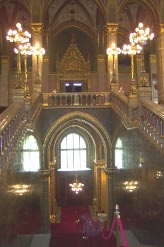
Royal Staircase--Parliament |
May 10 (Sat) - Budapest
The day started like the rest – breakfast in the apartment followed by cappuccino in the old market with the locals. We took the metro to Hero‘s Square – a huge square with massive statues depicting the history of this place – lots of violence, of course. Poor Hungary had the misfortune of growing up in the wrong neighborhood – always some bully to come in and take over – the Celts, Romans, Turks, Huns, Mongols, Nazi Germany, Soviet Union, French (I think Napoleon was here) and others.
After I photographed Hero‘s Square, we went to the Museum of Fine Arts – had some nice stuff – El Greco, Goya, Raphael, to name a few and oh, those wonderful scenes of Venice that look like photographs. How‘d they do that? Wealthy travelers from the 19-century would buy these paintings of Venice as souvenirs – pretty fine postcards!
Next we saw the Palace of Art – great neoclassical building, but strange art tucked inside. There were signs that said, “Zombies make Robots out of their children” and an endless video of homely Irish school kids saying the word “Celtic”.
Another sideline – the museums look recently renovated, but the grounds around them need work. We are lucky to see a few marigolds mixed in with a lot of weeds.
We took the metro to the TERROR Museum on Andrassy Street. The museum was the headquarters of the Soviet Secret Police and depicts the horrors of their rule. Wanted to go, but $25 was too steep. (Heck, you can get a box seat at the Opera for that!) The building looked impressive – I set a goal to learn more on my own.
Next we went to the Hungarian Photographic museum – lots of interesting Hungarian faces from the 1920‘s of people on the street, dancers, gypsies, etc. Love that period.
We had a leisurely lunch at an outdoor cafe where we‘d eaten before. It’s so much fun to watch the families enjoying the beautiful Saturday. After lunch, we hopped back on the metro to the Applied Arts Museum – another beautiful building. We saw a clock collection, china, furniture and not sure what else – getting too tired to focus, so we went back to the apartment for a quick rest.
At 6ish, we took the metro to Margaret Island. The island was a retreat for contemplating religious ideas from the 11th Century on. We walked around and had a beer – the highlight was a fountain that danced to some classical music (not particularly exciting, but the locals love it.) There are lots of people enjoying the place and the warm weather – how lucky we are.
We decided to have a real Hungarian dinner for our last night in Budapest. We found a quaint little place. There was a cute little piano player, photos of famous Hungarian actors and musicians, lace curtains, lace tablecloths and the most opinioned waiter we ever met. He insisted that I have the duck (a good choice) and finally allowed Bill to order a turkey / bacon / pastry thing (not as good). The waiter insisted on the strudel, but when it came time for the schnapps, Bill said – ENOUGH, we have to go. Funny place, fun evening. We came back to the apartment to pack for our next adventure to Bratislava.
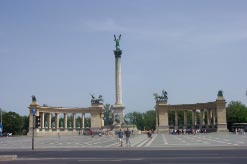
Hero's Square |
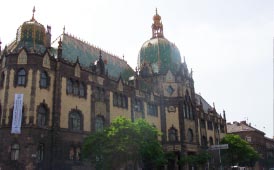
Museum of Applied Arts |
May 11 (Sun) - Budapest to Bratislava
Up early, packed and down to Platform 8. The train to Bratislava left on schedule at 10:10. We had a very fancy compartment -- 6 seats all to ourselves. The scenery was nice and mellow -- farmland, a few little medieval towns sprinkled through out -- nice touch, God!
We had a sandwich and split a beer on the train -- left us with only a buck in Hungarian. Bill got a cheese sandwich, I got ham -- then we mixed and
matched for a ham and cheese -- clever us.
We got to the Bratislava train station right on schedule -- 12:30. There were no English speakers (or they don't like Americans), so we had a tough time negotiating the ATM withdrawal, purchasing tickets to Vienna and finding transportation to our hotel.
Finally Tolley #1 got us to the Hotel, Kyjev. The dollar has fallen so badly that the $58/night room is now $70 and Bratislava is supposed to be the cheapest place on earth to travel. The hotel is a high rise built in the '70s. It looks and feels Japanese -- compact and comfy (good feng shui). We're on the 10th floor with a wonderful view of the castle on the hill and the charming old town below. One foot outside the old town is pure schlock -- an urban planner's nightmare – but the old town is unbelieveable -- charming buildings (historical stuff -- like where Wolfie Mozart played his first concert at the age of 6), squares, statues, cobblestone streets, open-air cafes and not a car in sight. You can really imagine how the town was – I was swept away by it's beauty,
Because the museums are closed on Monday, we only had Sunday afternoon to cover the prime museums and cover them we did.
First up the hill and to the castle museum (Historical Museum). We found more Nazi control freaks guarding the rooms, but there were wonderful displays of various guilds and their importance in the economic development (cobbler, locksmiths, potter, iron smiths). Then we saw some gorgeous period furniture. There was also a room featuring the oppressive Communist Government and then the velvet revolution in 1989 and the velvet divorce (the split between The Czech Republic and Slovakia). There was also information on music – very important in this culture. After that, we enjoyed the fantastic views from the castle.
After the castle, we had trouble crossing the freeway. Some stupid politicians / planners allowed this horrible freeway to cut across the main town, destroying about 2/3 of the original old town. Finally, back in the quiet little old town, we went to the Municipal Museum located in a beautiful old church. There was a special exhibition commemorating Bratislava’s first years, 1858 – 1918. This covered the rulers, the occupiers and occupied, and the people. That pretty much sums it up. The best part of the museum was the basement – the actual medieval torture chambers. These medieval guys really got off on torture – unfortunately we haven’t gotten too far beyond it.
The last museum was the Slovakia National Gallery – some nice things, but a lot of Jesus and Mary paintings and sculptures. Those artist guys weren’t very good at drawing Baby Jesus.
At 6 pm on Sunday, we reached our goal of 3 museums, so we rewarded ourselves with yummy Slovak beer in the main square. It was a lovely square with families and young lovers everywhere. Then we found a nice little Italian place for some pasta. The restaurant is inviting and sweet – played American tunes from the 50’s – like “Don’t know much about history ….” The food was just so-so; think we’re better off sticking with the travel guide recommendations.
After dinner in the quaint little town, we had to take a walk on the ugly side to get back to our high-rise hotel.
At 9, we checked our e-mails, then walked back into the main town square for a laser show projected on the church roof. It was delightful, simple and clever – colored lights drew pictures of the old church much to our delight.
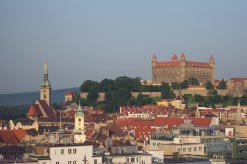
Bratislava - View from our Hotel |
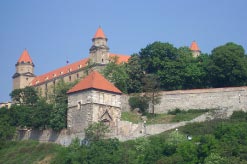
Bratislave Castle |
May 12 (Mon) - Bratislava
I woke up at 5, got up at 5:30, showered and got ready for the day. Bill was able to sleep in. I took some pictures from our room – pretty quaint old town on the left; ugly high rises on the right. We had breakfast at the hotel – OK German faire.
Our first stop was the post office to mail postcards. The second stop was the Tourist Office just to confirm that everything was indeed closed on Monday. Too bad, we really wanted to see the Primate Palace where Napoleon signed the Peace Treaty (after he was defeated). There were also no concerts in town.
We walked through the town and across the gosh-awful bridge Novy Most (New Bridge). It was built in the 1970’s to replace a charming little bridge bombed out during WWII. The bridge makes the beautiful Danube look sick. It has a high revolving restaurant hovering like a spacecraft above it. (It was closed for remodeling.)
We crossed the bridge to the alleged City Park – more like a weed field. Then we crossed back over the bridge to go to the one museum in town that was open–the Jewish Heritage Museum. It was nicely done, and there were no Nazi guards. Lots of torahs and religious stuff were displayed, along with instruments of circumcision. Only a small section presented the Holocaust. There were photographs of six Jewish guys who escaped Auschwitz to come back to Bratislava and warn the remaining Jews of the actual horrors.
We found a nice little restaurant, Kelt, with a delicious lunch of the day – garlic soup, chicken and forest mushrooms over rice. It was a charming place dating back to Medieval times.
After lunch we took a city bus (#29) to the end of the line (6 kilometers) to Devin Castle, an Old Roman Post dating from the 1st to the 5th Century. It was, of course, closed, so we walked around the grounds. Napoleon destroyed the Devin Castle in the 18th Century. War really messes up the neighborhood.
We really enjoyed our little trip out of town and mingling with the locals on the bus. We didn’t mind the BO, but the coughing was a little bothersome.
I’ll take the non-coughing section, please. Darn that SARS – makes you paranoid.
We came back to town and headed to our favorite watering hole in our favorite square. We finished our beers and our postcards. We also bought a puppet for Zi on the old square. (She loves to go to puppet shows.) We went back to the Post Office to mail the cards.
I stopped at the Internet Café to file the first trip report (and only report we managed to get out). After 2 or 3 hours, Bill came back to tell me he found a great little restaurant. The restaurant, Prasnabasta, was a winner, another cellar with authentic Slovak food. The darling waiter helped us pick out some wonderful dishes – meat, pancakes, potatoes, cheese, bacon and local beer, of course. Everything was very tasty. The waiter also took our picture. He never
used a digital camera before. He thought it was cool. There are no Americans to be found – mostly Germans and Austrians come to visit.
Bratislava was a nice stop along the way. We went back to our room to study Vienna, pack, and edit photos. And this was supposed to be a kick-back, relaxing day – we’re way too hyper. Tomorrow it’s Vienna.
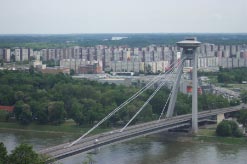
Novy Most |
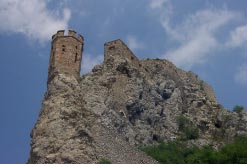
Devin Castle |
May 13 (Tues) – Bratislava to Vienna
Caught the 8:30 am train from Bratislava to Vienna. We’re getting to be old hands at riding the train – there are always two passport checks per border – once when leaving, once when entering. It reminds me of the old James Bond movies – I wonder what spy is hiding in the bathroom during these passport checks.
We arrived in Vienna at 9:30 in the morning. The train station was so efficient. Bill was able to accomplish all his tasks in no time – find an ATM to get Euros, find out how to get to town, get a Vienna transit card, exchange Slovak money into Euros. Bill loves the orderliness and efficiency. The closer he gets to Germany, the happier he is. All this neatness makes me a bit nervous. I almost lost Zi’s puppet running across the street – dropped it and retrieved it right before a car got to it.
We took the bus to the apartment – exactly as Ilse (the landlady) described. Sure enough, she was there waiting at the place and what a place it was (and only a 5 minute walk into the heart of Vienna’s historical district). The apartment is tucked away behind an old church, on a pedestrian street with lots of family restaurants nearby. What a warm, sunny, cozy, lovely place – plus is has a cool Murphy bed (my fantasy) and only $75 / night. There is a nice patio – Ilse asked if I would water her plants – no problem. Things were looking good. Ilse showed us where the market was. We got some things for breakfast, got change, paid Ilse, and then said “Good-bye.”
We grabbed a pizza at a place next to the apartment, then off to do Vienna. All our books recommended a Do-It-Yourself orientation tour on the #1 or #2 city tram that circles the ring of the old city. This ring, called Ringstrasse, was built when the old wall was torn down. Ringstrasse, completed in 1880’s is a grand old boulevard.
The Do-it-Yourself tour was not very interesting. From the speeding tram, we couldn’t tell what was what. We got off at the next stop to check out an impressive building, “Rathaus.” Then it started to rain – what happened to our sunshine welcome? We dashed back to the next trolley and got off at the Kunsthistoriches Museum, which was on our “Must See” list so we paid the $12 US each and spent the rest of the afternoon tucked inside. At one point, we heard an incredible downpour on the roof. When we looked out, we saw rooftops and grounds covered with ping-pong ball sized hail – what’s going on here? From 80 degrees and sunny to cold and hailing in a matter of minutes. So glad to be inside, exploring one of the richest and finest art collections in the world.
Facts about the Kunsthistrisches (Museum):
The museum was built between 1871–91 when the Ringstrasse was constructed and contains collections from generations of Hapsburg monarchs. . My favorite 3 R’s were there – Rubens, Rembrandt and Raphael (among other non-R greats). I loved the self-portraits of Rubens as he aged. We rented the audio sets to tell us what we were seeing – well worth the cost.
As usual, there were loads of Madonna and Child paintings and depictions of Bible stories – David and Goliath, Sermon on he Mount, and my favorite, The Tower of Babel with some cool geometric shapes. After covering the extensive art collections, we visited the wing of nobility to view the court portraits and artifacts (robes, crowns, jewels, etc.) from the powerful Hapsburg dynasty.
Aside from giving us a headache, this wing introduced us to the long line of characters from 640 years of a powerful reign. (NOTE: A lot of royal inbreeding produced a severe under bite, along with epilepsy and other ailments.) My favorite monarch was the Princess Maria Theresa (from Spain) promised to Franz Josez I at the age of 2. The marriage turned out to be surprisingly “happily-ever-after.” Maria Theresa produced 16 kids, 13 survived childhood. She married off 9 daughters as political maneuvers to increase the boundaries of the empire. She only let her favorite daughter marry for love. Unfortunately, one of her daughters, Marie Antoinette, married King Louis XVI of France right before the French Revolution and lost her head in the process.
In any case, Maria Theresa ran the kingdom (1740–90) while her dear Franz Josef studied geology and natural sciences. She was so powerful that some leaders said, “Hapsburgs finally got a man to rule and he turned out to be a woman.”
Maria Theresa did a lot besides producing children. In the late 1790’s, she abolished torture and serfdom. She was more tolerant of non-Catholics than her predecessors. She established 8 years of compulsory education for everyone and loved little Mozart. When he was only 6, he performed for her. After the performance, he jumped into Maria Theresa’s arms and kissed her.
My other favorite ruler was Emperor Franz Joseph I (1857–1916). Franz became king at 18. His powerful mother, Sophia, convinced his dad (her husband) that he (the Dad) was too weak to run the empire, so he turned the crown over to his young son. Franz was a popular ruler until his 80’s when he died.
Franz Joseph’s parents arranged his marriage, but Franz fell madly in love with his bride-to-be’s sister, Elizabeth (Sissy), who he married when she was 16. He was in love with her his whole life while she was miserable. She hated being queen. He loved to hunt, she hated to see any animal killed or injured. He called her “Cuck-Cuck” at times and she was. She was obsessed with her looks, her hair, and her weight. She barely ate and had a workout room, all this when it wasn’t fashionable. She was 5’ 8” and weighted 100 pounds. She didn’t like the king and didn’t like their kids. She rode horses, took long rides, traveled constantly (mostly incognito). At age 61, in 1898, on a trip to Geneva, an Italian anarchist stabbed her in the heart with a file. No more Sissy and a very sad king.
Poor King Franz Josef had a lot of sorrow. His troubled son, Rudolph, heir to the throne, committed suicide along with his lover while at a hunting lodge on a weekend getaway. Franz Josef also lost his brother Maximillian who left to rule Mexico (pressured by his ambitious wife, the Princess of Brussels). Mexican revolutionaries assassinated him.
Enough of the Royalty. The stories go on and on, better than anything National Inquirer could come up with. We were consumed by the Emperor Wing of the museum. The museum closed before we had time to see the massive Egypt section.
We walked back to our wonderful apartment, against a flood of thousands of “Pensioners” marching to protest a proposed cut in funds for their pensions, PLUS higher taxes to support future retirees. Sound familiar? Why aren’t Americans up in arms over Social Security?
We stopped at the market to stock up on breakfast foods, beer and water and then went back to the apartment for a beer. We decided to have a bite at the neighborhood Greek Restaurant – delicious.
We came home happy campers. Bill started to do the wash while I researched tomorrow’s activities when all of a sudden we heard a loud pop and then no lights. Bill flipped a switch in the bathroom (a light had a short circuit) and pure darkness. We scrambled around, found some flashlights and the circuit breaker box – no luck when we flipped the breaker. Bill had to get in touch with Ilse. He had to dress, find a pay phone outside in the rain, find some kids to interpret the operator’s instructions and finally ring Ilse. She suggested a makeshift solution, which restored most of the lights and scheduled an electrician for tomorrow.
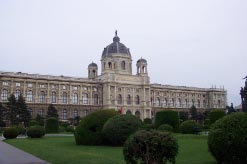
Kunsthistrisches Museum
|
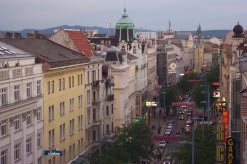
Rooftop view across from our apartment |
May 14 (Wednesday) - Vienna
We had breakfast in the apartment and went to the free Internet down the street (Vien Energy), but it was busy. Then we went to Big Net (really nice Internet café with a high-speed connection), but Yahoo was down so we couldn’t check e-mail. We decided to go to the Hofburg Palace, where the Hapsburg emperors lived until 1918. The castle started in the middle ages and has expanded as the empire and family did, resulting in 640 years of different architectural styles all stuck together.
We first visited the Imperial Silver collections. Of note were:
1. Maria Theresa’s dining utensils. She used them at every meal, even had her servants take them along when she traveled. She loved to eat and was very particular about having her own silverware (or should I say "gold" ware?).
2. Elizabeth (Sissy) -- She has been compared to Princess Di - a mysterious, narcissistic, beautiful, anorexic empress. We saw crates of china, silver and plates that traveled with her entourage when she went from place to place. Even had a palace built for herself on the Greek Isle of Cofu, but decided not to live there after all.
3. Little remaining silver -- most was melted down for money to fight the Napoleonic wars.
4. Exquisite gifts from son-in-law Louis XVI (after his marriage to Marie Antoinette) including China, porcelain and a big gravy bowl. These gifts were used to cement the political (and family) ties and were most fascinating to me.
5. Mugs with royal insignia -- given as souvenirs to the lucky poor and old (NOT sick) people who were invited to lunch with the King and Queen during the holiday season.
Now off to the Royal Apartments to get a peek at how these folks really lived. We saw:
1. A large room where folks waited for an audience with the king – Each citizen had a right to visit the king. One waiting room had a pool table to help pass the time.
2. The audience-with-the-king room -- Franz Josef meet up to 100 citizens two mornings a week until he was 80 (1915).
3. Conference Room for cabinet-like meetings. There were only fountain pens and parchment paper on the large conference table -- not a computer in sight!
4. Franz Josef's study -- Family photos were on his desk -- pictures of Sissy, children, and grandchildren. He loved his family. The servants' quarter was hidden behind the wall panel. About 20 servants in total served Franz Josef.
5. Franz Josef's bedroom - very Spartan - iron bed, portable washstand and place to pray each morning to ask for divine guidance.
6. Misc. Rooms - Great Salon / Small Salon – Smoking rooms for men after dinner. They would not be caught smoking in front of the ladies. One room was dedicated to Maxamillian, Franz Josef's brother who was killed in the Mexican Revolution in 1867.
7. Empress Bedroom (Sissy's quarters) - There was a dressing room with gym and a cooper bathtub. Servants worked 2 hours a day on Sissy's ankle-length hair. Sissy commented that she felt her brains were being extracted through her hair as the servants washed and combed her hair. Sissy loved animals, especially horses. She was aloof from people and estranged from the king. She traveled a lot for her numerous escapes.
8. The Empress’s Great Salon had a Mediterranean theme with travel posters. She would not allow photos or portraits to be taken of her after the age of 30 – vanity thy name is Sissy!
9. Alexander Apt. - Red Salon - 1776 gift was a wall hanging from Marie Antoinette and Louis XVI in Paris to their counterparts in Vienna.
10. Dining Room -- only for the family. Spartan settings - used silver, not gold. Each meal had 9-13 courses with the responsible Chef's name printed on the menu next to his creations for that evening. Talk about accountability!
11. Successor's Room - dedicated to Franz Josef's two heirs (Rudolph, committed suicide in 1889) and Franz Ferdinand - his nephew who was assassination in Sarajevo in 1914 leading to WWI.
PALACE ACCOMPLISHED - back on the street to look for the phone to check on the status of electricity with Ilse. We walked up the famous Karntner pedestrian shopping street and right into St. Stephan Church. OH WOW, what a place – but impossible to photograph – so large and so penned in by surrounding buildings. We grabbed a hotdog (AKA “bratwurst") on the street and dashed off to catch the 1:00 English tour of the Opera House.
Opera House - Staatsoper - opened 130 years ago. Critics hated it, causing the architect to commit suicide. The Opera was bombed heavily during WWII with only one grand room left standing. The rest was rebuilt without the riches and backing of an emperor. So sad, not at all lavish and elegant like the Budapest Opera House. However, there are incredible productions -- 300 performances a year (none in July and August) and about 50 different shows a year, never repeating the same show twice in a row. A real production nightmare -- changing sets every day. Very expensive tickets - up to $150. 95% of the seats are filled and the state still must subsidize 2/3’s of the budget. The really greats performed here, including Hayden and Beethoven.
After the opera, Bill caught the Metro back to the apartment to met with the electrician. I chose to walk around and get lost in Vienna on my own—a very nice experience. There are so many amazing streets and alleys. Of course, I took a lot of pictures. After an hour and half of ambling, I decided it was time to get along home and find my way back to the apartment. Bill was pleased. The electrician found the short circuit and now we're back in to a fully functioning apartment and I mean fully functioning.
We made a stop at an Internet cafe and then walked to the folksy Snitzelwirt Schmidt, little family restaurant tucked away in another quaint Vienna neighborhood. The guidebook said that the waiters are “temperamental” from having to carry such large portions from the kitchen to the table. We negotiated a smaller plate of schnitzel and fries. What a great cholesterol fix - deep fried and yummy.
On our way home, we took Ilse's advice and went to the 5th floor of a building across from our apartment and got some magnificent views of the area -- including the beautiful little church that sits in front of our apartment.
NOTE: Didn't sleep well - so got up and drank the a little bottle of welcome wine from Ilse -- Did the trick. Also my tooth is hurting (antibiotics until the inevitable ROOT CANAL when we're back in the States)
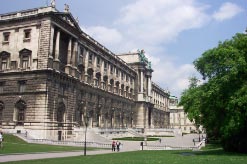
Hofburg Palace
|
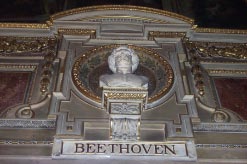
Vienna Opera House |
May 15 (Thursday) - Vienna
We took a metro (about 4 miles) to the Schonbrunn Palace – got there about 9 am. This was the Hapsburg’s summer palace. It was huge – 1441 rooms. The interior was finished under Maria Theresa. A bomb hit the palace during WWII, but luckily the bomb turned out to be a dud. We visited the apartments of Franz Josef and wife Elisabeth (AKA Sissy) plus those of Maria Theresa. We learned about all these characters the day before in the Hofburg Imperial Apartments. They duplicated their “stuff” in this magnificent summer palace that rivals Versailles.
Sissy liked to come here, sneak down the windy staircase and ride her horse or walk for hours on the beautiful grounds. Also located on the grounds is Europe’s first zoo (Tiergarten) established by Maria Theresa’s husband who wanted something to entertain the guests. It’s still open today, but with the world famous San Diego Zoo back home, why waste our time? We walked through the gardens to the Gloriette – decoration only. We passed on the expensive cup of coffee.
We returned to the city and to the Big Net to check our e-mail, then we found a noodle place recommended in Lonely Planet – Ramen. It was very good and we had a very sweet, helpful waiter.
After our noodle lunch, we headed to the Leopold Museum in the Museum Quarter, featuring Austrian art. Sprinkled throughout the Museum Quarter grounds were these large blue cubist looking recliners. It was a beautiful sunny day and lots of people were sprawled out over these interesting objects.
The Leopold Museum was opened in 2001 with funding from Dr. Leopold. He collected mostly Austrian expressionists and some others -- Oskar Kokoschka, Alfred Kubin, even one by Gustav Bamberger (a nice country scene). It was in this museum that we discovered our favorite -- Egon Schiele, 1890–1918. He was obsessed with death (and life) and so very passionate. There were 200 of Schiele’s paintings. From the audio guide we learned about the Vienna Secession movement. Gustav Klimt was the leading secession proponent. He is famous for the painting, “The Kiss.” Beautiful – the faces were painted in great detail while the smocks were impressionistic and done in gold and silver trim.
There were also displays of furniture and artworks by Otto Wagner, Josef Haffmann and Kolo Moses. Wonderful things.
The main attraction of the Leopold was a traveling Toulouse Lautrec exhibit –nicely done. We learned a lot about T.L. He came from Albi (south of France), and hung out at brothels and the Moulin Rouge in Paris. He was a graphic artist hired to do posters announcing the performances throughout the Paris in-scene. He lived for a while in the Mont Martimer area in a room next to Edgar Degas. He did a lot of studies of prostitutes and performers. He contracted syphilis and died a crazy man in a sanatorium. I loved his characters with their pinched out faces and pointy noses and the large, dramatic forms that dominate his posters. He worked in layers (much like Photoshop and other software packages).
My head was hurting with so many visuals and information. We dashed across town to catch the 3:45 pm tour of the mother of all churches – St. Stephensen (spelled like my dentist name – reminds me of that impending root canal). Our tour guide was a big guy and a real character. He pointed out (among other things):
--Vienna’s first landmark
--Gothic architecture – 14 – 16th century, Baroque sections added in the 18th Century. Unfinished North tower
--The North tower’s big bell is 21 tons cast from canon balls captured from the Turks in 1683.
--Survived the bombs in WWII, but gutted by fire
--Austrians contributed to the reconstruction effort and left their coat of arms as their marks in the church.
Re-opened in 1948.
--Famous for the sandstone pulpit – priests delivered sermons there. It was built around 1500. The sculptor’s torso and head is carved into the pulpit. On the handrail leading up the pulpit are lizards (representing light) and frogs (representing darkness) and at the top of the handrail is the dog of the Lord so the toads can’t get into the pulpit
--The significance of numbers were represented everywhere. On the pulpit 3 wheels represent the trinity and four wheels represent man.
We saw Eugene of Savory’s tomb and the Baptism area. Our guide talked a lot about the sacraments. However, we weren’t a very religious group and couldn’t answer the questions he asked (except for a cool black woman in the group).
On the way home we checked the Internet. We rushed home and made ham and cheese sandwiches, wolfed them down and then were off to the concert at the Rathaus.
The concert was a benefit for the JUNG Philharmonic – so the performers were YOUNG (high school kids). They did a nice job and the performance was a big deal. TV cameras were there. High society ladies with fancy clothes, ratted hair and make up like Elizabeth Dole were there. Some of the ladies gave long-winded speeches (in German, of course) and everyone who was anyone got a huge bouquet of flowers. The concert was good – fine for music-impaired folks like us. A young, beautiful opera singer was out of this world. She still hadn’t learned what to do with her hands – and appeared a little tentative. At the VERY LONG intermission, all the fancy people were downing what looked liked Vienna sausages and delicate chocolates. It was fun to observe such a celebration and help the kids out. We took the Metro back to our place. Bill did the laundry. I edited the pictures – so many.
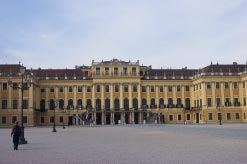
Schonbrunn Palace
|
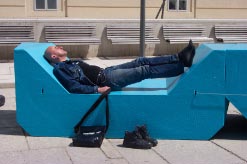
Local Resting on Street Furniture |
May 16 (Friday) - Vienna
After breakfast, we checked the train schedule and then off to the Belvedere Palace. The palace belonged the Prince Eugene of Savoy (1663-1736). The prince was the Commander in Chief of the Imperial Army who conquered the Turks and Napoleon. We saw his statue guarding the castle in Budapest. His niece inherited the palace and later sold it to the Hapsburg family. It then belonged to Archduke Franz Ferdinand who was assassinated in Sarajevo in 1914, leading to WWI. Now the palace is owned by the Republic of Austria.
The upper Belvedere was constructed in 1721-22, but Prince Eugene never lived in the upper Belvedere. Instead, it was used for aristocratic galas. On the second floor was the red marble room. Khrushchev and Eisenhower (Ike) and others from France and Germany signed the Austrian State Treaty in 1955 ending the 10-year occupation of Austria by the Allied powers. Currently the upper Belvedere houses an art gallery featuring works of Klimt (The Kiss), Egon Schiele, Kokoschka, Amerling, and others, mostly from the Vienna Secession movement.
In the lower Belvedere, where Prince Eugene once lived, is a baroque museum – cool medieval art. We loved the funny faces and statues. We walked through the gardens. They hadn’t put the flowers in yet – but were ready to go. We left the palace and on our way to Karlplatz, we stopped and had a nice Thai lunch.
Our next stop was the Sigmund Freud House (Berggasse 19). Freud moved to Vienna with his family when he was only 4 and later became the Father of Psychoanalysis. He lived, worked, and received patients in this house from 1891 to 1938. He fled to London to avoid the gas chambers. It cost him one third of his net worth. He never liked London because his language was taken away. His four sisters were all murdered by the Nazis.
Freud loved to travel and bring back antiquities. He also incorporated the themes into his work. Every Tuesday evening, a discussion group met at his house.
He loved to smoke. He said he couldn’t write or research without a cigarette or cigar. He experimented with cocaine before much was known about the drug. He helped his friend overcome his opium habit by giving him cocaine, but then his friend became hooked on cocaine. Oops.
His daughter, Anna, also studied psychology and did a lot with children. Anna also kept all the furniture and belongings – hat, cane, trunk, etc. The Freud family liked to make movies. Several were showing when we were there. I fell asleep watching them. Bill said I was snoring. Nice, interesting cozy place, but a terrible reminder of the Nazi terror. On the wall next to Freud’s apartment was a plaque that listed the Jewish neighbors that were taken away and killed.
After the Freud House, we came back to the apartment, had a beer and crashed. Bill woke me to see if I wanted to go the Pirates of Pensance – too much to do – so we passed. Instead, we took the metro to the Am Hof area to check out a few recommended restaurants. We found a nice little place about 300 years old. The place was quaint and real, except for the goofy medieval outfits they made the waiters wear. A proper couple and their dog sat next to us in the dim cellar. Dogs are adored. The waiter brought the dog water. We ordered beef goulash and pork. It was filling and good. After dinner we walked for miles – mostly getting lost in this wonderful city.
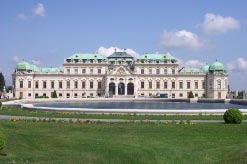
Belvedere Palace
|
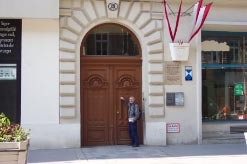
Bill Knocking at Freud's Door |
May 17 (Saturday) - Vienna
Our last day in Vienna – After breakfast, we walked through the famous Naschmarkt. We had seen a painting of the market from centuries ago and not much had changed. The stalls went on for miles. We loved the food section with gorgeous fruits and veggies and then the wonderful smells of baking breads and other aromas.
Then we walked through the City Park. There was a grand piano statue with cactus growing on it.
To satisfy my death fix, we went to the crypt – Kaisergruft under the Kapuzinerkirche. This was the imperial crypt founded in 1619 by the Catholic Emperor Matthias. There were rows of ornament caskets – 138 Habsburgs are buried here. The caskets depict sad lions, skeletons wearing crowns, and famous battle scenes. My favorite was a huge double casket for Maria Theresa and hubby Franz Joseph I. They were sitting up in their royal garb smiling at each other. In another sad wing was a painting of Franz Joseph, the last emperor, and Elizabeth (Sissy the Anorexic and beloved crazy wife who was assassinated). On the other side of Franz was their son Fudolf who committed suicide with his girlfriend. The last of royalty was Zita who died in 1989.
After our weird crypt experience, we took the self-guided Mozart tour where we saw
· where he lived with his parents and sister
· where he hung out in Bohemia Square
· where he rented a room and then married the landlord’s daughter
· where he married and had his funeral services
· where two of his six kids were baptized
· where he entertained (and hung out with) Maria Theresa – even had Christmas with the queen one year.
· Where he wrote the Marriage of Figueroa (at the Figueroa House)
· We never did find his signature on a wall in the alley in Domgasses 5.
After our Mozart walk, we toured the Figueroa House. Mozart lived in the Figarohaus from 1784-87. Here he wrote the Marriage of Figueroa and many of his greatest hits. There was a whole suite of rooms with wonderful views of the narrow street below. We looked in amazement at the original manuscripts. This was said to be the happiest time of Mozart’s life. I noticed a guy sitting in the corner listening to Mozart’s music on headsets and whistling along with the melody in pure ecstasy.
During our Mozart Exploration, we stopped for fuel – a pizza and a beer at Pizza Bizi – a local chain. It was good.
Our last stop of the day was to visit the famous Plaque Statue I wanted to see since we arrived in Vienna. It turns out that we’d seen this creepy statue at least five times and didn’t know what is was. IT was a strong, exotic monument from the 1600’s. The people in medieval times didn’t know the cause of the plague. They just figured it was a punishment from God. Emperor Leopold, who ruled during the plague, had this statue constructed in gratitude. Below the emperor is FAITH, with a stupid cupid tossing out an old naked woman, who symbolized the plaque, into an abyss.
Having completed our Vienna list, we walked back to the apartment, stopping to check the Internet. Then we decided to eat at the local Italian place just around the corner from our apartment. I just had a simple penne and tomato sauce. Bill had lasagna. Teeth are acting up again – not too good.
We went back to the apartment, packed and went to bed early!
INTERMISSION – Observations of the People in Vienna
· Love their dogs
· Have very few children, but children are treated with respect.
· Proper / polite, but not necessarily friendly.
· Higher class of people because the public transit smells better
· Vendors on the street serve hotdogs on glass plates and beer in glass mugs.
· Very little traffic – mass transit system great.
· No massive parking lots.
· Polite drivers – stop for pedestrians.
· People follow the rules – don’t cross until the light is green whether a car is in sight or not.
· They dress up to go shopping – men in suites and jackets.
· Woman wear high heels – even over these cobbled stone streets.
· Recycle grocery bags – pay for a bag if you forget yours.
· Strictly business – definite answers to your questions.
· Elegant stores – lots of money.
· Funny to see WWII movies dubbed in German
· Funny program on TV – imitates David Letterman. Did a great job.
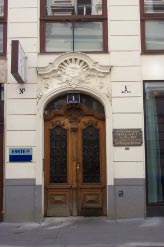
Where Motzart Played First Concert
|
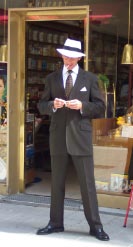
Cool Guy in Vienna |
May 18 (Sunday) Vienna to Cesky Krumlov (Czech Republic– Southern Bohemia)
Had a quick breakfast and then took the Metro, luggage and all to the train station. Our train left at 7:05 am. We had to change trains two times.
Right outside of Vienna, the country was green, but flat, then as we got into the southern Bohemian part of the Czech Republic, the countryside turned into rolling hills – green and windy. The train stopped at almost every little town. I had hoped to get caught up on my journal, but the twisty tracks made me Train Sick.
We had a close connection at one stop and our train was 5 minutes late. We ran like crazy to get to the right platform. There were 4 to 5 passport agents / conductors outside the train who know at least one English word – RELAX!!! So we did and got on the train. Hyper Americans – they’re too much. We had a nice ride. We got to our destination, Cesky Krumlov and, with no sign of a bus, we found one lone taxi driver who took us to our pension for about $3 – really steep price, but worth avoiding the a long walk.
Cesky Krumov means “Czech bend in the river.” The enchanting town is dominated by a castle high in the hills (established in the 11th Century) with a very windy river below. It’s one amazing place – cheap and charming with buildings and street scenes to knock your socks off. It is touristy (unlike Bratislava), but you don’t mind. Every corner is a new incredible sight.
We got to our pension, Mysi Diro on Roosevelta Street about 11:30AM. Our room wasn’t ready, so we took off to see the town, crossing the river several times on the old cobblestone road. We walked to the Tourist Office, checked the Internet and then selected a wonderful little restaurant for lunch. The restaurant, Na Louzi, is on a town square. A cute guy was our waiter. We had beer, dumplings, sour kraut, pork, beef. Hearty and good and cheap – like the travel guide promised.
After fortifying ourselves, we walked up the hill to the castle – called the Cesky Krumlov Chateau. We climbed the tower for some fabulous views and then took a tour from a shy little Czech gal. She said the Chateau is haunted by a white lady who appears to forecast doom. She also told us about the nobility that lived here since the 12th Century and their associated coat of arms. We saw the dining room fitted out the silver platters, bowls and other settings. China was too expensive. These guys were not the Hapsburgs. They had a more modest lifestyle, but still not bad, considering.
The chateau had big enamel furnaces to keep the place warm along with lots of tapestry and other wall hangings and bearskins (with heads still attached) covering the floor. Later we learned that bears were (and still are) kept in the moat to discourage invaders. We saw one of the two bears the next day hanging out in the moat. There was an elegant carved carriage painted gold and used only once to take the chateau’s owner from Rome to the Vatican City (not very far) to offer the Pope lots of gifts – what a waste. There were lots of portraits of the nobility – ugly looking lot. One emperor accidentally killed the husband of one of the countesses (also happened to be his lover) while the two were out on a hunting trip. (If you believe that was an accident …. Well …) We saw the bedrooms, the dressing rooms, the chapel, the salons, ladies rooms, smoking rooms, and my favorite room – the whimsical large theatre with hundreds of puppet-like characters at a masked ball. The artiest was from Venice. It was a beautiful, fanciful room. There are great views of the little town from many windows.
After the castle, we walked back to our room and what a nice surprise! The room was arty, charming – all wood floors and furniture. Three big windows overlooked a wonderful view of the Vlatava River and the park / bike path behind it – All this for $40 a night. Would have been $29 if the Bush administration could manage the economy. The soft dollar is experiencing a melt down. Oh well, what can you do?
We were so surprised to find three prints of Egon Schiele (framed in wood, of course) hanging in our room. He was the Austria Impressionist and part of the Secession movement in Vienna. His mother was a Bohemian from Cesky Krumlov and in 1910-11 Egon came back here to paint the wonderful scenes. Bill’s favorite picture, a house with clothes hanging outside, is in our room – it’s a small world. We settled into our wonderful, cozy room. Bill did the hand washing and I tried to catch up in my journal and keep my tooth from hurting.
We went out in the evening trying to locate some Lonely Planet-recommended restaurant, then it started to rain a little, so we said, “What the heck – let’s go back to the place where we had lunch.” The same waiter greeted us. We told him we only wanted small beers. The ones at lunch were much too big. So he kept joking about our “baby beers.” I had a veal cutlet stuffed with ham, cheese, potatoes and cabbage and lots of other veggies – so good. Bill had the “Chief Cook’s Secret.” I’m not sure what it was because it was a secret.
My tooth started to throb after dinner, so I got on massive doses of Advil. We watched a little TV. (“Ed TV” was playing – still funny after all these years.) We fell asleep before 9 pm – we were exhausted. It rained during the night. We expected lots of rain tomorrow. Predications weren’t good – but the sun held firm and gave us another beautiful day in the Czech Republic.
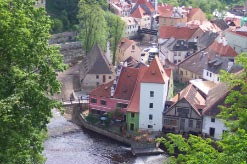
Vlatava River from Chateau Tower
|
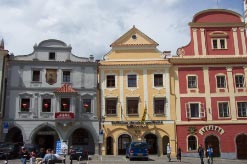
Cesky Krumlov Town Square |
May 19 (Monday) –Cesky Krumlov (Czech – Southern Bohemia)
Up early – breakfast served in our room at 8. Very nice – juice, coffee, rolls, cheese, ham, jam. Then we gathered up our heavy bunch of dirty clothes and went to the one laundromat in town called Lobo. Everything is so arty and cute here – even the laundromat has a charming painting hanging over the dryers.
During the wash cycle, we explored the castle (chateau) a little more. We saw a bear in the moat and then went to the Royal gardens. We saw some actors rehearsing a play. We also saw about six vans with Czech TV written on the side. The vans were loaded with props and lights – definitely a major production going on here.
During the dry cycle, we looked for souvenirs and bought water at a grocery store. Only cost 6 crowns verses the 50 crowns Bill had to pay at a restaurant last night. (25 Crowns equal $1.) Laundry costs $4 – expensive – but that’s Europe. The machines take so long to do a load here.
After we folded the clothes, we went back to our pension. Later, we walked down to check out the bus station for our departure tomorrow. Bill had to wait for an Info person, who couldn’t speak English. Looks like it’s 9AM on platform 1.
We had lunch at the place next to our pension. The menu had a section for children and a section for treats for your dogs! Very interesting. We sat out in the sun next to the river. The poor waiter and waitress had to dress in medieval attire. We just had a small beer, two bowls of garlic soup, King Somebody’s wooden plate of cheese and meats plus a loaf of rye – all for under $10 for both of us. The mustard was very hot for me and may have kicked in my throbbing tooth again. Wish I had taken care of that problem back in the States.
After lunch, we explored the Regional City Museum. Saw some really ancient stuff – bits of pottery and some iron pieces. There was a large model of the city – interesting. We saw a lot of church carvings, portraits of royalty along with family trees of the castle (chateau) royalty. One cabinet displayed those Guilds again with the top hats, boots (cobbler) and others. There were also display cases of the typical dress (on a really fat model), farm equipment, and furniture pieces. The labels were not in English – so it was difficult to tell what I saw. However, the photo exhibit room needed no explanation. There were photos of the devastating floods of August 2002. The Vlatava River that runs through Cesky Krumlov also runs through Prague. Pretty bad, almost ruined Prague. The last room was filled with ugly, muddy art pieces from the locals, I assume. Certainly not the greats or any one from the secession movement! Yuck!
We left the Regional City Museum and want right to the Egon Schiele Art Centrum (www.schieleartcentrum.org) Regional Art Museum. They had a big collection of Salvador Dali works and a permanent collection of Schiele (plus lots of information on his life). It was a wonderful old museum in an old building.
Dali gives me a headache and there were rooms and rooms of his stuff – over 500 pieces, mostly lithographs. We saw his bullfighters, Alice in Wonderland series, 3-D weirdo stuff, crazy photos of him holding an egg, etc. (I swear Dr. Seuss got his inspiration from Dali.) Then there were the really, really weird ones – ants, animals, sex organs on strange creatures. How scary to live in his mind.
Finally we got to the Egon Schiele section – He produced so much work in his brief 28 years. There was a very early drawing of trains that he did when his father was the stationmaster in Tullen, Austria. The family lived by the train station. He had two sisters and grew up in Vienna. His father died when he was 15. The older Masters discovered him. He did a lot of shows and the critics were harsh. He lived here in Cesky Krumlov (where his mother was born) for a year. The folks chased him out of town because of his work with the young local girls. Also displayed was a nude photo of Egon as he posed for a life drawing class. He married and moved back to Vienna and was doing great. He headed the Vienna Secession Movement and designed the graphic for the movement . . . then there was a letter he wrote to his mother telling her that his wife (six months pregnant) had contracted the Spanish flu and not to expect any good news. The wife died on Oct. 28, 1918 and three days later, Egon died of the flu as well. The final photo of him looked like an aids patient. There was also the death mask.
After the museum, we walked to the Eggenberg Brewery, founded in 1560 and still operating. (Must have been state owned when Czechoslovakia was part of the Soviet Block.) We sampled some brew with the locals at a picnic table under a tree and then bought Brian, our beer-loving son-in-law, a tee-shirt. These guys were pretty ugly; bless their souls – not like the beautiful people who can afford beer at the lovely cafes in town. An exceptionally ugly drunk Czech guy motioned that he wanted to take our picture with my camera. He was slobbering and tripping and trying to line us up in the viewfinder. When we got the camera back we discovered that the image he captured in the photo was our feet, way up in the upper right corner. Let that be a lesson. Then he went over to another table to say “Hi” to a little girl and accidentally knocked her mother off the bench. Get me out of here!
Later we did a little shopping. The only thing I wanted belonged to the storekeepers and they were not willing to part with their gypsy shawls trimmed with fringe. Next we went to St. Vitas Church. I snapped one picture – didn’t know it was a No-No – OOPS. There were lots of ropes with warning alarms. We tried to climb the tower, but it was locked. Across from the church was a dance class with little ballerinas at their little bars.
We came back to our room, watched a little CNN, more suicide bombers in Israel – just to mess up the whole alleged “Road Map for Peace.” Is there any hope?
We took a nap, then went to dinner next door downstairs by the river. The place was crowded. We had to wait a long time – but it was well worth it. I had trout. Bill had pork stuffed with mushrooms and onions – plus beer all for only 12 bucks. YUMMY!
We walked around the quaint little town and came back to pack. A big storm is blowing through. The trees outside our window are bending down with the wind and heavy rain. I sorted through our pictures. I finished one memory card – holds almost 500 pictures – Oh Wow!
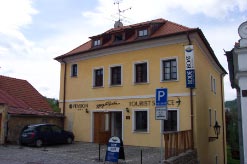
Pension Mysi Dira - Cesky Krumlov
|
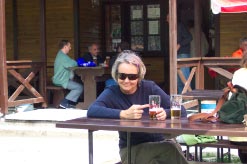
Nancy Sampling the Local Beer |
May 20 (Tuesday) –Cesky Krumlov to Prague
Had breakfast in our room at 7:30. It’s chilly and damp and rain is expected. We rolled our stuff to the bus station. We met a guy traveling from Brazil and two girls from Taiwan. The girls were nice and friendly, but we kept our distance (SARS) and were glad when they didn’t cough. The bus ride was only 30 minutes to Chesky Bodejovice, From there we caught the train to Prague.
While we were waiting for the train to Prague, Bill bought our tickets (Prague to Krakow and then on the overnight train from Krakow to Budapest). The woman couldn’t speak English and later we learned she had really screwed up both reservations. She gave us second class tickets and then booked two double sleepers. The price was over 3,000 for the supplement. Bill straightened out the whole mess once we got to Prague. The transaction took forever and a long line was forming.
We grabbed a sandwich and boarded the 10:28 train on platform 3 to Prague. By then the rain had started. I waved at school kids in the next train over and then took some pictures, of course.
Unfortunately we couldn’t see much of the countryside on our way to Prague because most of the train tracks were in the trenches. We studied our Prague books and had lunch.
We met a real Looney Tunes middle-aged lady on the train, originally from Prague, but now living in Australia. She was on her way to Prague for a family reunion. She said she was a retired transportation engineer. She travels the world seeking miracle cures. Of course, she’s been to California. She didn’t care for our own Depak Chopra. Next she is going to see a once blind man who did some eye exercises and now has 20/20 vision. Then she’s off to South America to see a guy who will operate on her hip using his bare hands. She was spooky.
We arrived in Prague at 1 and there was Juri, from the Lida Guest House, to greet us. He brought us “home.” We’re staying in the new wing of an old house built in the late 1920’s. The room is very modern and very Architecture Digest-like. Juri’s brother, Thomas, is an Architect and designed the room. It has lots of light, clean lines and bright colors – yellow walls, yellow satin quilt and bright blue drapes and chairs. The bathroom is also slick – only a glass wall separates the shower from the rest of the bathroom and the rest of the room.
After we unpacked, Juri served us coffee and tea and had us sign the guestbook. He gave us a map and his cell phone number. He also shared his travel books. We were good to go do Prague now. Juri did warn us about the pick-pockets everywhere in Prague. Just this morning, some guests at his house were taken on their way to the castle.
We walked to the Metro and bought a 7-day pass and then to the train station to straighten out the train reservation mess the last train clerk had made. They charged us for the change in reservations – just to rub salt in the wounds.
We bought a good map of Prague and headed to Wenceslas Square. We passed the old Opera House, then the National Museum (wonderful building, terrible museum – travel books say – Don’t bother). Then we walked down by the magnificent statue of St. Wenceslas on his horse with four guys guarding him. It’s a huge statue and there were crowds everywhere. Wenceslas Square was loaded with touristy souvenir shops, but somehow, it didn’t detract from the incredible architecture styles. I was snapping photos like crazy. My eyeballs couldn’t take it all in.
We stopped and had a quick ice cream on the street – only 40 cents (10 Crowns). Next we walked to the Old Town Square just in time to see the Astronomical clock on the church do its magic right at 4 o’clock. Saints, Jesus and other characters look out the windows while another character rings a bell. There were masses of people gathered to watch this event (and masses of thieves watching the tourists watching the clock). Of course I snapped more photos of this amazing place.
Then we found an Internet Café called the Bohemian Bagel. Signs were posted everywhere warning people to “Watch Your Stuff.”
Then we went down to the famous Charles Bridge and walked over it. There were artists, musicians, vendors, statues (fakes – the real ones are in the museums), crowds, and of course, the ever-present pick-pockets. The views from the bridge were wonderful – Castle on the hill, other bridges, cool buildings, etc. We had to rub one dog figure on a statue for good luck. (Later I found out it actually brought bad luck.)From the Charles Bridge, we crossed over to the Castle section and found a cool place to grab a beer. We loved the old medieval bar. We got the waiter to take our picture and then I took pictures of two guys having dinner. Why must we do this while traveling? Great to be silly with fellow travelers.
After our beer, we crossed back over the Charles Bridge and caught the #17 tram back to our little neighborhood. I took pictures of the Czechs on the streets waiting for the tram – so much to observe.
We ate at a little family restaurant in the neighborhood that Juri recommended. I had chicken curry and Bill had chicken Andalusia. We were both happy with the food, but it took forever and there were lots of smokers and one little obnoxious red haired boy ho appeared to be about six. Glad when we were finally able to get our check and leave.
We came back to the room and watched some CNN – more threats of terror in Saudi Arabia and maybe the U.S. We watched part of a quiz show where a woman was in a dentist-like chair with flames all around her while her heart rate displayed. Strange. I did my journal, read and went to sleep.
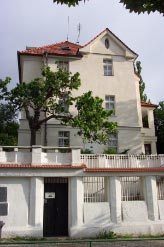
Pension Lida - Prague
|
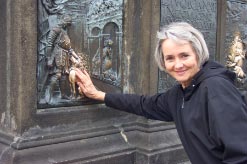
Nancy at Charles Bridge |
May 21 (Wednesday) – Prague
We enjoyed a nice breakfast at the guesthouse and then caught the Metro to the castle side of Prague. We walked up the 100 plus romantic steps and had some beautiful views of the city. We went inside the castle area and watched the changing of the guards in their little guardhouse.
We waited for the ticket booth to open at 9:30. The headset vendor wasn’t there, so we had to visit the castle without the accompanying guide.
Our first stop was St. Vitus Cathedral. St. Vitus had a neurological disease – and that’s where the term St. Vitus dance came from. The stained glass windows were out of this world. They used lots of little pieces of glass. The cathedral, ordered by John of uxembourg, was started in 1344 and finally completed in the 19th and 20th centuries. There was a rose circular window on the front wall and lots of great gargoyles with gutter spouts coming out of their mouths decorated the building. The cathedral has a golden portal and flying buttresses like Norte Dame’s in Paris.
Within the Cathedral, we saw the St. Wenceslas Chapel, built in 1372, with the Gothic frescos of Christ floating – all done in red and jewels. St. Wenceslas’ casket was in the chapel as is the door that leads to the crown jewels. It has seven locks with seven keys -- one key for the president and the other keys for the highest-ranking Czech officials.
There was another amazing casket -- the tomb of St. John Nepomuk. It was intricatesilver crafted from solid silver in 1736. We went down into the crypt to see the royal tombs. Charles IV was there with four of his wives. In the chapel itself was the Royal Mausoleum. Buried here are Ferdinand I (died 1564) with his beloved wife and son Maximillan II.
We climbed the steps to one of the towers with more magnificent views. We would have enjoyed it more if it weren’t packed with school kids – oh brother. We noticed that most of the kids were sweating and winded after climbing only a few steps. They’re like our American kids back home.
Later we learned that the stained glass windows we saw in St. Vitus were done by Jews. At the bottom of the windows, written in Hebrew, were advertisements for ewish Banks and other companies. Jews here formed the first insurance companies and banks and this was their subtle way to get the word out.
After exploring St. Vitus, we went to the Royal Palace. In one of the rooms, a man with a coat draped over his arm bumped into Bill. Bill reacted quickly and clutched his wallet – all was OK – no missing wallet. Bill pointed out the guy to me and we both observed the guy who was observing the other tourists. He was working with a sexy babe. They kept motioning to each other. When he saw us discussing him and his activities, he and his babe quickly moved on.
(We would not be so lucky escaping the pick pockets later on the Metro coming home during rush hour – with about 8 thugs who jostled Bill, grabbed his wallet and took off unning before the metro closed its doors and pulled away. Not a good day. They got about $30, credit and ATM cards. We spent the rest of the evening canceling those suckers. We had to call Amy for help because one bank wouldn’t accept a foreign call. Using the phones here is not that easy. Juri, our innkeeper, was very helpful. Oh well – now Bill and I watch everyone like a hawk. Petty crime in Prague is REALLY BAD. On the bright side, they haven’t moved into assaulting and murdering their victims yet.
Now where was I? Oh yes, visiting the Royal Palace (and without headsets, oh dear – just have to make up our own stories).
The castle was built in the 11th Century and has different architectural layers – Ramanesque Palace (1135) forms the cellar currently holding caskets. Charles IV and remsyi Otaker II added their own palace above it in the 1490’s. The top floor contains the massive Gothic Hall – In the 17th century the hall was used as a public market and for indoor jousting competitions.
We loved the big hall. We also saw the throne room (for parliament). It was destroyed by fire in 1541 and rebuilt in 1563. On May 23, 1618, 100 Protestant noblemen led by Count Thum marched into the palace to protest against secession of the intolerant Hapsburg Archduke Ferdinand. The two catholic governors and their secretary were thrown out the eastern window. They fell 50 feet, but survived by landing on a dung heap. The Catholics believed that God was on their side because their guys lived to tell about their fall. However, the event triggered the beginning of the 30 Years War. We saw the All Saints Chapel built for Charles IV so that the royalty would have a nice place to worship in private.
After the castle, we visited the basilica – St. George’s Convent – simple Romanesque building with high arches. Some important people were buried below the altar.
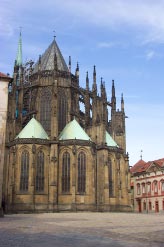
St. Vitus Cathedral
|
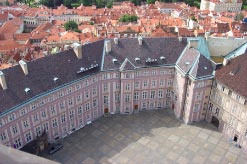
View of Royal Palace from St. Vitus |
Next, we strolled through the Golden Lane, built in the 16th Century. The tradesmen quarters (lots of tiny little houses) are built right into the Castle wall on Golden Lane. They looked like tiny Hobbit Houses. Now ritzy tourist shops occupy the houses – places to buy jewelry, candles, books, glass, even armor and swords. Franz Kafka, born in Prague in 1883, lived and wrote in No. 22 (a tiny blue house on Golden Lane) during the years 1916 – 1917.
After visiting Golden Lane with hordes of other tourists, we walked back through the palace gardens and then came upon the square where military guys were marching while about a dozen other military guys stood at the windows playing marching music – a noontime thing – brief, but exciting. We sat on the steps and listened to a fun Prague band while we figured out where to eat. We found another great recommendation from the Lonely Planet – had beef goulash with potato dumplings.
We walked around and saw Parliament, Loreta, and the Foreign Ministry (with an entourage leaving – was Powell in town?). Then we crossed the St. Charles Bridge – always lively with crowds, musicians and artists.
We found the Bohemian Bagel Internet Café and checked our mail. Got e-mails from Amy and Lynda. I bought a used kid’s book – I liked the old medieval illustrations.
We shopped around and found Bill a replacement Swiss Army knife (he lost his on the train). It was a spooky store – lots of guns, knives, weapons of all sorts. The place was loaded with teenagers drooling over the handguns – getting to be more like the U.S. everyday.
Bill found a Magnum (that’s ice cream, not revolver) – so he had his fix. Then we headed home on that fateful metro ride with the pickpocket thugs and the rest is history.
Bill finally got the credit cards canceled and we got cash before we canceled our ATM cards. (Now we’re walking around with lots of cash – a really comforting feeling.) Juri was a great help during this ordeal. We went out for a great dinner in a nearby neighborhood – both of us ordered beef fillet with Roquefort sauce and potatoes – to die for. We rode the metro home without a pass – the thieves are using it now. No one was there to check, so we made it just fine.
Came home. Bill washed and I wrote in the journal.
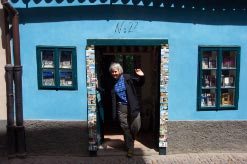
Nancy at Franz Kafka's
|
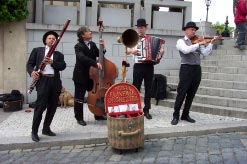
Prague Street Band |
May 22 (Thursday) – Prague
As luck would have it, I found a crazy brochure in the Bohemia Bagel Internet Café advertising the services of George, the guide. I thought we needed an insider’s view of Prague, so we did as the brochure instructed – we met George at the park by Charles IV statue at the base of the Charles Bridge. For 300CZK ($12 each), George showed us the town and told us so many great stories.
George was a computer operator in 1986. He also worked with his father making ammunition for Winchester. His sister was a teacher and made very little money. Teachers and other professionals had little support from the Communist Party, who thought manual labor to be more important. They did have some nice times on family outings on weekends under the Communists. George is now 39, has two kids, and is married. He lived in New York City and took Czech tour groups to National Parks in the U.S. He likes the U.S., but didn’t want his kids to be educated there with the low educational standards and all this “I love you … You love me Barney stuff.”
According to George, living under Communism was not so bad, once the people learned and accepted the system. The Communists wanted to make sure the people were happy and wouldn’t cause any trouble. Buses took people to church, to shows, etc. The Communist Party provided everything – free beer, cheap meals. There were problems getting to the stores. Everyone worked from 6am to 3 pm. The stores were open 9 – 5. Sometimes the Communists made artificial shortages – toothpaste, etc., but the protestors only came out when the price of beer went up.
History / Facts (I think they’re facts) we learned from George:
History of Prague
6th Century – Jews settle here to escape from Monguls. The Jews settled in the southern part of the city while the Germans settled in the northern, swampy part. Prague was at the crossroads of lots of trade routes (e.g. silk) – a great position of power.
7th Century – Germans provided services (repaired wagons, washed horses, etc.) Jews were in the slave trade with the Barbarians – but it was a good service – like providing laborers, not like the U.S. slave trade with Africa.
9th Century – Czechs settled in a little town near the castle.
10th Century –Crusades started. Catholics came through and practiced on the Jews. The Jews moved under the castle with the Czechs for protection. Czechs had no problem accommodating the Jews – have a “Live and Let Live” philosophy.
11th Century – Prague got its first king . The time had come because finally Prague had enough money to buy off Caesar and get a kingship. These guys were Bohemians.
The first king, Vraislav II (1061 – 92) was a Christian, so the Jews had to stop their slave trade. The German area was not safe. They had to build a wall. It was a smelly place with the tanning chemicals, smelly horses, smelting, etc.
At that time there were three towns
Big Town – German (now Old Town)
Little Town -- under the castle (now Castle Town)
Prague Town
The king brought builders from everywhere to build churches, palaces, and bridges. He got Italians and French to design and build the town.
14th Century – Luxemburg’s -- King Charles IV (1346-78) – King of Bohemia and Holy Roman Empire. King Charles was very smart and a great leader. For 40 years, he had no war (even with the 100 year war going on between the English and French). Charles IV married four wives and had 12 kids. He married them off to the right political leaders so he could also become the father-in-law of many of important rulers elsewhere. The first one was France. Charles IV lived to age 67. When he was 18, he had an injury to his neck and was a little handicapped his entire life. He could not walk straight. He died of pneumonia. He spoke four languages, read all the time, understood people. When he needed the Old Town Square to be elevated, he asked farmers who came to the Square to sell their produce to bring a wagon of dirt to dump, then they would not be taxed on their goods. That way he got the old Square elevated and stable.
He was a great builder. While he was king, he built the Charles Bridge (dedicated in 1357 at 5:31 AM). It’s still standing today. He believed in Astrology and opened the bridge precisely on the correct second, minute, day. He got and architect named Peter and German workers to build the bridge. It took 27 years. A clever statue of the bridge architect (Peter) can be seen. Peter is putting his hand up a nun’s skirt and she appears to be very happy about it. Charles IV also built the university (first German speaking University) and Monte Carlo.
After Charles IV died of pneumonia, his oldest son, Wenceslas IV (1378 – 1419) became ruler, but he ruined the kingdom and lost Caesar kingship –because all he wanted to do was to go into town with his bodyguards and drink at the pubs. If the bar owners didn’t give enough beer, or if the beer wasn’t good, he’d have them put the beer into a basket and dunked into the river from the Charles Bridge for public humiliation. His younger brother, Sigismund took over during the years 1419 – 37.
One of the kings, suspicious of his wife, asked a priest to tell him what his wife said at confession. The priest refused to divulge the information and the king ordered the priest executed. Later, the king’s highly trained dog “accidentally” attacked and killed the Queen (yeah right!). That’s the story depicted on a statue on Charles Bridge. The travel guides say rubbing the dog will bring good luck – not so because the dog was the king’s accomplice. I rubbed the dog and later, Bill got pick-pocketed.
During the 13th Century there was great religious unrest. Jan Hus, the university’s first Czech Rector and reform preacher was executed for heresy in 1415, which led to the Hussite wars. Then after a lot of weak kings, the Austrian Hapsburgs took over, ruling for 400 years. (Rudolph II, the enlightened, brought the Renaissance to Prague.)
Anyway, the Hapsburgs were very Catholic. They stuck Catholic statues up on all the buildings and bridges. They were intolerant of others. The poor Jews got the worst of it. They were forced into a ghetto – with in a few weeks, all the Jews had to move to one area. There were 20 people per room and everywhere rooms (and buildings, of course) were added. There was no air, no sanitation, a lot of sickness.
The Catholics also had it in for the Protestants. Remember the Protestants were angry and had thrown some Catholic officials out the windows of the castle. (Catholics survived by falling 50 feet into piles of dung.) That started the 30-year War. The Catholics retaliated and chopped off heads of 27 Protestants in the Old Square, plus the heads of a couple of guards who were too lenient with the Protestants. Don’t mess with a Catholic. The Snow Mountain battle also played a role in the Protestant / Catholic conflict.
After 200 years of intolerance, many of the educated and higher ups fled to Holland, England, Scandinavia. The uneducated Czechs could not escape. It was a brutal time. Usage of the Czech language and books were banned. The monks up on the hill saved some of these books and locked them up in their bar. The Czech culture was gone. The Germans took over with their language, their beer, the pork and dumplings.
In the 19th Century, proper society people began putting the Czech language back by a “slip of the tongue.” Now the Czech language is spoken with German grammar. 1886-90, a Czech theatre was built for Czech performances. Later a Czech ballroom was built on the Island.
In 1918, King Franz Joseph fell (after WWI) and Czech and Slovakia became united as Czechoslovakia. Czech was the leading nation. Hitler made a deal with Austria to take over Czech Republic (Austria agreed). On May 5, 1945, Prague was occupied by Germans. The Radicals took down the Nazi signs so it looked like the war was over in Prague. For four days, they waited for Americans to liberate them. Then on May 9, 1945, the Russians came and took over. The Americans agreed to let Russia take Czech Republic. That’s why Czech went Communist – because England and France gave them away to the Nazis and America left them to the Soviets.
George told us wonderful stories. One was about a knight who was a ladies’ man. He got into a sword fight with his lover’s husband and lost the tip of his nose. He had it replaced with gold. His casket, in the Tym Cathedral, shows him with the golden tipped nose.
What George showed us around Prague:
· Observatory – longest operating in the world and the first to detect global warming
· A fascinating sculpture in the lobby of the main library – hollowed out tower constructed of old books with a mirror at the bottom. What interesting illusions it gave – almost made one seasick.
· Where the oldest violins were made
· Elaborate wood carved signs over doors of the shops where merchants once lived and did their work – Violin, Brewery, etc.
· The flood line / water mark left by the flood of August 2003
· Where a huge statue of Stalin once stood – It was blown up. It took lots of dynamite to do the job. The statue was replaced with a huge metronome on top of the fill.
· Where Kafka and Einstein lived – both houses were on the Old Town Square. Kafka and Einstein were friends and had many discussions.
· Recommended a place called Sever Cockroaches for lunch – think we’ll pass.
· The area where the Lennon Wall stands – a wall of graffiti named for John Lennon because there is a large drawing on Lennon displayed on the wall.
We said our good-byes to George and left him with his next clients – a very proper English couple. What a treat they are in for … We headed to the closest lunch place (where we had beer on our first evening in Prague). I had grilled chicken and potatoes – wonderful seasonings and spices. Bill had beef soup (more like a stew) served in a hollowed out round loaf of bread. We were pleased.
We accidentally roamed by the American Embassy in Prague. What tight security -- guards / secret service types checking every car on the block. Even using mirrors to see under each car.
We spent the afternoon at the Decorative Arts. We headed back to the Jewish section of town, where the Decorative Arts Museum is located. George advised us to skip the Jewish Museum and Synagogue – too expensive and not much on display. The neighborhood is now an elegant French looking place – tree-lined blocks with wonderful old apartment buildings. In the 18th and 19th centuries, with the help of the Hapsburgs’ wealth, the once Jewish slum was transformed into a wonderful place. This was an age of building beautiful cities within your empire – and the French were looked up to, so today, Prague has a little French Jewish Quarter. The area started out as swampland, first occupied by Germans with their smelly industries (horses, smelting, etc.). Some Jewish developers began buying up (under assumed names) the cheap land that nobody wanted and turned it into a fashionable upper class section for the Jews. Then came the Hapsburgs (very Catholic and intolerant) forced all the Jews to live there – so the lovely area turned into slum almost overnight.
Hitler loved Prague and spared it from WWII bombing strikes. His concept was to keep Prague as a museum for the first extinct race of people. He thought this Jewish section of town was an ideal place for such a museum because of its wonderful diversity. At one time there were 130,000 Jews in Prague, then after WWII, only 60,000 were left. The synagogue didn’t look like much. Its claim to fame is that it is the longest operating synagogue. It still has the old fashion services conducted every Sabbath. The other interesting thing is the Jewish cemetery – over 100,000 Jewish people are buried there – in a very small plot. They’re buried layer upon layer. Looks like they have about layered-out. Rather than spending lots of money on tickets for admission to the cemetery, we took pictures of the place from the second floor of the Decorative Arts building.
At the Decorative Arts museum, we saw five centuries of arts and crafts – dresses, Catholic robes, trunks, wardrobe cabinets, Bohemian glass, knick knacks, graphic arts, books, posters and so on. The best part was the temporary exhibit of those cool art nouveau posters advertising serving machines, bikes, movies, plays and one series for the Vienna Secession Movement – amazing that young Egon Schiele has come back to haunt us once again. We bought some cool cards for our friends back home in the gift store.
After exploring the museum, we walked back through town, checking every suspicious character. This place is crawling with pickpockets. We stopped at the House of Mirrors to inquire about the 5 o’clock string quartet. The little old lady offered us a discount – but not enough for us. She had spent a year in New York City as a young girl and was so sad that she didn’t get to live there.
We went on in search of the cheapest beer in Prague proper. On the main square, the price is up to 100 CZK (that’s $4), but not far away, tucked away on a side street, we found the same beer for 16CZK (75 cents). Nice little bar – cellar with light pouring in from the high ceilings. I named it the Boob Bar because the murals painted on the wall featured bare breasted women and the decorative ship mast was a bare breasted lady. After our beer we walked up Wenceslas Square, looking at the amazing architecture with one eye out for pickpockets. We stopped and peeked in at the Hotel Europa. The main area was closed – they’re shooting a film. The dining room was wonderful.
Outside, I continued to snap more photos of the magnificent statue of Charles IV on his horse and some from the National Museum. I also took some pictures of the Radio Free Europe building – strange Russian modern design.
We took the metro back to our hood and stopped to eat at a Fellini-esk restaurant. Very strange experience – packed with so many drunks, mostly old guys, but some younger ones in their soccer suits. One table was reserved for a group of mentally retarded folks from a nearby home. The large murals painted on the wall were weird -- Soviet leaders having sex with Marilyn Monroe. Can’t even begin to describe what I saw. The food was good and lots of it, but we had to sit crammed in with six heavy smokers (and heavy drinkers). Beer rules in this here part of the world.
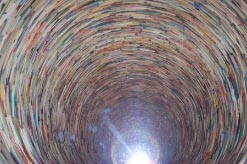
Book Sculpture at Prague Library
|
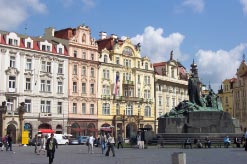
Prague Old Town Square |
May 23 (Friday) – Prague
We walked to Vysehrad Castle in the neighborhood. A sweet older couple showed us the way. They were so sweet – arm in arm. She had patches on her jacket and even on her shoes. George, the crazy tour guide, said when communism (the Velvet Revolution) was replaced, the hardest hit were the nearly retired – like this couple. Their dreams of the state taking care of them in their retirement years were completely taken away.
Back at the Vysehrad castle—had wonderful views of Prague from the top of the walls. The moats were filled in and tennis courts built on top of them – very interesting. We first visited St. Peter and St. Paul church, built in 1880. There were lots of school kids around. The wonderful Vysehrad cemetery is a 19th century National Czech cemetery where famous artists are buried, including Antonin Dvorak (1841-1904). There were lots of artists, musicians, writers, professors – so many statues of the heads and one cool dancer.
After the cemetery, we walked along the wall, then happened by the museum. What a treat. We learned about buttress buildings and casements. A little old guide took us deep into these casements. They were very dark with only a few air holes from above. He also showed us how they designed the thick walls for shooting without being shot – narrow openings for the rifle with alcoves designed for the soldiers to hide behind. There was so much effort and expense to build these tunnels and not one gun was shot from here. The guide told us that Faust is performed in this deep, dark dungeon every summer. In the theatre area, the guide showed us about six or seven statues. These were the original statues from the Charles Bridge – Copies are on the bridge now. The real ones are placed in protected areas around the town to keep acid rain from ruining them. The coolest statue I saw was Jesus’ grandmother – St. Anna, holding Jesus. Mary was also there. We also saw a statue of Wenceslas when he was a child – his mother was teaching him something.
After the castle, we walked along the river. We saw some amazing architecture –a cubist house, “Fred and Ginger” building– looked like Gaudi was here – designed by American architect Frank Gehry who also designed the Guggenheim Museum in Bilbao and the Disney center in LA.
We walked by the Czech National Theatre and then crossed the Legi Bridge, south of the Charles Bridge. We walked up the street to a memorial on a hill with about a dozen simple iron statues of men coming down the hill on marble steps. Each had various parts of the figure missing. The plaque said it had something to do with 1942.
We had lunch at the Bohemian Bagel, right across from the memorial – loved our tuna bagel and chicken wrap – what a relief from all the red meat.
We walked to the Old Square – wanted to check out the Tyn Church and see the casket of the ladies’ man who lost his nose – and replaced it with gold. The church wasn’t open until 5:30, so we left.
We saw where Albert Einstein lived on the Old Town Square. He didn’t live there long. His wife wanted to get out of Dodge. He saw trouble brewing for the Jews and was tired of the arguments – Are we German? Are we Czech?
We finally figured out the big old statue in the Old Square – it commemorates the famous protestant Jan Hus. He was judged a heretic in 1415 and burned at the stake. 500 years later, in 1915, they built a statue. These guys don’t forget a martyr. Jan gave his life rather than denounce his beliefs.
We went up the Old Town Hall Tower, built in 1364. We took a glass-encased elevator for some glorious views of the town and more photos, of course.
On the Old Town Square 27 protestant leaders were executed on orders from Emperor Ferdinand on June 27, 1621 after the battle of White Mountain. Next we went into St. Nicholas church, 1703 – It had a massive chandelier shaped like a crown. After checking off all the must-sees in the Old Town Square, we returned to the “Boob Bar”.
We took the metro back home, watching the pickpockets work the crowds. Back in our room, we edited the pictures until my finger couldn’t hit the delete button anymore. Then we walked around our neighborhood and stopped into a place Juri recommended. The waitress spoke English – no English Menu. She was just a kid. She learned English in high school. We ordered a delicious chicken baked with cheese, peanuts and onions plus the typical potatoes. Fat and happy we returned to our room where Bill did the wash and I wrote in our journal.
P.S. – Juri told us he was in the student protest in 1989. After the velvet revolution he and his brother Jan and Mother Lida bought this old house and started a guesthouse. It’s a thriving business now. Just think where Juri would be if the revolution didn’t turn out to be “velvet?”
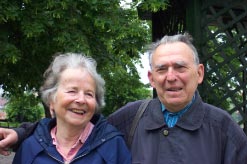
Couple Who Showed Us Vysehrad Castle
|
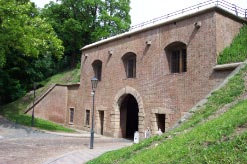
Casement Museum at Vysehrad Castle |
May 24 (Saturday) – Kutna Hora
We took a 9:05 train to Kutna Hora, 45 miles east of Prague. Before we reached Kunta Hora, we got off the train in Sedlec and went to visit the Ossuary. It was decorated with the bones of 40,000 people. In 1870 a local carver arranged the bones and people have been coming from everywhere to see his work.
After seeing all those bones, we walked to Kutna Hora. In the 14th century, it was the second largest town in Bohemia after Prague. It was a wealthy silver town – minted silver for European currency until 1746 – over 400 years of currency and power. Because of the rich silver, the small town in the second half of the 13th century, the king took over the licensing of Kutna Hora. In the 14 century, 5 to 6 tons of pure silver was extracted each year – so the king got to be the richest ruler in all of Central Europe. Now the town is a quaint place with a UNESCO World Heritage label.
We walked around town and stopped at the Visitor’s Center. We grabbed a quick lunch – Mexican for me and cold soup for Bill. We went to see the main church in town – Cathedral of St. Barbara, began in 1388 by Peter Parlet, architect of St. Vitus church in Prague. St. Barbara was completed in 1547. It’s a beautiful, gothic style with flying buttresses – three massive tent-like shapes. Too bad, it was closed for lunch, so we missed the interior.
At 1 pm, we toured the Hradek Mining Museum with a Czech guide and about 25 Czech folks. We first saw the 15th century palace with all its riches. Saw the rooms – Chapel of St. Wenceslas, banquet room. We also saw the religious suits and the silver guild men’s ceremonial robes and suits of armor knights wore to protect the place. We saw a huge wooden device used to lift up the rock from the 200-meter deep shafts. There were also manikins of miners and silver coin makers busy at work. The best part of the tour was putting on our miners’ helmets and white coats. Carrying heavy flashlights, we went deep down into the medieval mine shafts beneath the town. The tunnels were very narrow and part of the time we had to walk bent over.
After our tour of the mine, we caught the 3:05 train back to Prague, then caught the Metro to our place. It’s a warm, beautiful sunny day. We found Juri lying out on the lawn, playing with his puppy while his wife was gardening.
We picked an Italian restaurant near the Old Town Square for dinner. We wanted to have one last look at this magnificent city – pickpockets and all. So many people were out. We found the restaurant—just what we wanted. When we ordered our typical “small beer,” they brought us two tiny / shot glass-sized mugs These folks take beer drinking very seriously – no ordering small beer around here. They were joking and quickly replaced the shot glass mugs with regulars. We got a salad, pasta, margarita pizza and ice cream (on the house). We sat by the open French doors in the No Smoking section (rare). A very nice Saturday night in Prague.
After dinner, we checked our e-mail at the Bohemian Bagel Internet Café. We had an e-mail from Amy. She and Zi watched a video on our TV bed, then Brian came down to spend the night. It was nice to get news from home. We walked over the Charles Bridge and found the John Lennon wall – mostly graffiti. Tomorrow it’s Poland.
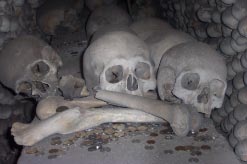
Sedlec Ossuary
|
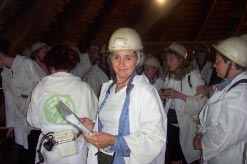
Nancy in Hradek Mine Museum, Kutna Hora |
May 25 (Sunday) – Prague to Krakow
Up early, we made sandwiches for the train at Juri’s and had breakfast. Said our good-bye’s at 6:30 and were at the train station way too early. We saw a guy wearing a security jacket that said, “No Nap Security.” Wonder what kind of translator they hired?
The train arrived at 8:03. We went to our reserved compartments only to find it filled with six big, tough looking Czechs who didn’t respond to our request to get our seats. Because, we’re not stupid, we went to the next vacant compartment. A beautiful Polish girl, Viola, was there. She is now a U.S. citizen and a graduate student on a school-related tour. There was also an old guy with the worst B.O. you can imagine. When the ticket taker came by, he kicked the poor old smelly guy out of our compartment. No B.O. allowed in first class, I guess. I can breathe again. Viola paid for an upgrade to stay with us. She was charming, fun interesting and only 25. Bill was smitten. She’s getting an MBA from some school in Boston. She told us all about her travels and family. She’s on her way to Krakow. She left there as a teenage. Her dad got a green card – wanted to get out of the communist rule – mainly so his children would have more opportunities.
We only had to change trains once on our way to Krakow. I think I re-injured by hip hurrying to get the luggage down on the platform.
Such beautiful countryside. I dozed off when Bill and Viola were talking about business. Bill woke me up before I started to drool. Classy American I’m not.
The Polish Passport Checkers were so friendly. One was so impressed with all the country stamps on our passports we’re collected over the years.
Viola is so beautiful – blonde and blue eyed, all the porters, passport guys, and ticket takers couldn’t do enough for her. She kept saying, “Oh, the Czechs are so sweet. Oh the Polish guys are so nice.” I finally said they’re so nice because you are so beautiful.
We finally arrived in Krakow – 35 minutes late. We said good-bye to Viola. Her two cousins picked her up. Then we dragged our suitcases to the Jordan Guesthouse from the train stations – only a ten-minute walk.
We got settled in – on the 5th floor of an old building (top floor). The place seems nice – accept for the wacky polish construction – the baseboards wave in and out in several places. It is very clean. I love looking down at the view of the old Krakow apartments wedged in by our guesthouse. This place also has a glass elevator. The breakfast / dining, called Magellan’s Library, is in the basement. It’s very nice, except for the stupid, dusty old Magellan dummy sitting at the table to greet you on your way in.
We showered, got our things squared away – had a little problem with the safe. Nothing quite works right here, it seems.
We headed for the main square in town. The houses and buildings leading from our room just up to the square are OK, but not like the amazing stuff we saw in Vienna and Prague. But then, as we entered the square – Oh Wow! Biggest square in Europe. It was Sunday about 6PM – had to find a Kantor to get some polish money (Zlotys) – not easy on Sunday. The square was full of life – everyone was hanging out enjoying the place – especially the families. They had kiddie car-rides (for a fee) and horse and buggy rides for adults (for a fee). We loved the street theatre – street musicians and teenagers doing amazing break dance routines.
We picked a café right on the square and had a beer. (Viola recommended Zwelig beer – so Zwelig beer it was!) Beer costs 5 Z – (3 Z = 1 dollar). We paid about $1.50 for a beer in a classy sidewalk café in the largest, most elegant square in all of Europe. Life doesn’t get much better. We sat back and watched the people stroll by on that wonderful balmy Sunday evening.
We picked out a little restaurant from our Lonely Planet guidebook – highly recommended – said it was like a country kitchen. It turned out to be a little too country kitchen – everything was staged like a Walt Disney production. The food wasn’t bad though. Bill had a cabbage dish and I had these dumplings like our neighbor, Nadia, makes (stuffed with meat or potatoes) and boiled. They served great bread before dinner with two kinds of spread – one was cream cheesy with leeks and the other spread was pure lard – No thanks!
We came back to the room about 8:30. Bill washed and I listened to a tour tape (left in the room) about Krakow – slept through most of it. We were both exhausted!
Viola on Train to Krakow
|
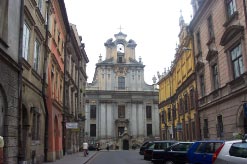
Krakow Street near our Hotel |
May 26 (Monday) – Krakow (Auschwitz)
It’s Memorial Day back home. Having a Big-To-Do in our old neighborhood – missing the place and little ZiZi. Something special is going on here, too. Most churches are having services. We saw a lot of little girls in white “first communion” type dresses. Lots of families are out. Viola said family is the most important in Poland. Money second. She also said 20% – 25% of the Polish people are unemployed. Our Prague guide, George, said that the Polish government committed their troops to fight the American war in Iraq in exchange for green cards. He said just watch the numbers of Polish immigrants to U.S. increase dramatically.
Decided to visit Auschwitz today. Got up early and had breakfast at 7. We rushed to catch a bus (lined up at the train station). We finally found the bus – not a lot of English speakers hanging around the train station. It cost about $3 each to go 40 miles to Oswieun. The bus didn’t even get out of town when a car hit us. We waited for the police, for the repair guys, etc. Finally the next bus to Auschwitz picked us up about 9:40 so we were off again. We felt sorry for the bus driver. The accident was not his fault. All the Polish guys involved had to get out of their cars and smoke massive amounts of cigarettes immediately.
We arrived in Auschwitz at 11 am, just in time to view the 15-minute movie and then take the tour from 11:30 to 2:30. The movie was done by the Russians in the 1940’s after liberating the camp on 1/27/45. So many horrible sights – piles of bodies in mass graves, skinny starving people, etc. The movie featured several individual cases – a little boy shot in the head because he shared his bread with someone else; some women who survived with horrible stories. The old film was in the 1940’s documentary style with loud emotional music and loud narration behind the black and white footage. It was a lot to take for 15 minutes
After the film, we met our guide – a serious young girl in her 20’s with fake red hair. She really knew her stuff and was intent on keeping to the tight schedule and sharing as much information as possible with us. I snapped away and tried to keep up.
Our first stop was through the famous Auschwitz iron gate seen in so many movies. The words in the arch said, “Work Shall Set You Free” – when the truth was work would kill you and death will set you free.
Auschwitz was first built in April of 1940 as a prewar army barracks for Polish soldiers. The barracks were made of solid red brick. The place was originally intended to hold Polish political prisoners. Another camp, Birkenau, was constructed by the Germans to the west of Auschwitz. These places were designed as factories whose sole purpose was to eliminated 1.5 to 2 million people from 27 nations – 90% were Jews.
Our guide pointed out where an orchestra played everyday – there were many great musicians imprisoned here. They were forced to play German marches and the prisoners had to march to the music after each long, hard day of work and without food.
Auschwitz was only partially destroyed by the fleeing Nazis. There were about 30 prison blocks – a dozen or so were made into the state museum Auschwitz- Birkenau. Our guide first took us through these cellblock museums, crowded with people. According to Viola, all Polish school kids are required to visit the museum and write a paper on their experience –and there were a lot of school kids there.
The first buildings (cellblocks) gave you an overview. Auschwitz was designed to be the central extermination factory. Jews from Scandinavia, from Rhodes in Greece, from all over were brought here. There were several smaller concentration camps located along the routes. From these camps, the great railroad system brought them to Auschwitz. A huge map on the wall shows this system with the network of camps, all located close to the railroad stations.
There were also large, wall-sized black and white photos of prisoners arriving with their bulging suitcases. They were told to bring their things. They were just going to be transferred to a better place – lies by German Nazis to control the crowds. When the prisoners first arrived, the men were separated from the women and children. A doctor “examined” them to determine who could work. The examination was conducted immediately after a long train ride with no food, no water and little air. The weak ones were sent at once to the gas chambers. The others were placed in the barracks.
For food, they got a little coffee for breakfast. For dinner, they got a little soup (no meat - cooked with the same vegetables used for the animals) and a piece of bread. They were supposed to save half of the bread for their breakfast, but they ate all of the bread for dinner because the people would kill each other for their half of piece of bread.
The beds were designed to sleep 15 in 3 bunks -- that’s 5 per small wooden bed. The slats were at an angle so the excrement would roll down. The area was very swampy with lots of rain, mud – miserable conditions. There was a lot of disease – especially typhus. When some of the Nazi officers started getting sick, one barrack was added for a bathroom – two long rows of about 50 holes all lined up. They were only allowed to go to the bathroom in the morning and after work at a set time. All crowded into this one bathroom barracks. There was fighting between themselves – all planned by the Nazi’s.
The guide told us that the people who survived the train trip could work only for 2 to 3 months before they were gassed. However, a lot of them died of sickness or disease. They didn’t go to the hospital because they would die there for sure.
Our guide showed us a large open area in Auschwitz where the prisoners would gather every morning to be counted and humiliated or killed by the Germans. She always used the word “Germans,” not soldiers or Nazis. From this spot, the prisoners left at 6 am to go to work, building more cell blocks, working in mines, sorting through belongings of the arriving prisoners, extracting gold from the teeth of the dead, emptying the latrine, etc. Then they would return to the same area at 3 pm to stand for another 3 hours to be counted and humiliated again.
She showed us the gallows where several Jews were hung because they tried to escape. There was also an execution wall where anyone stealing food or accused of other misdeeds was publicly shot. The Germans made the prisoners strip to further humiliate them as they were being shot. The Germans established no set rules – sometimes you were killed for stealing, other times not. One never know what to expect, which was all part of the plan to create constant confusion.
Nothing was wasted. There were 36 warehouses of things taken from the Jews and other prisoners. Hair was used for weaving cloth. This provided proof after the war because the cloth was tested and found to have cyanide in it. Gold extracted from teeth was sent back to Germany to be melted down into bullion. Canes and wooden legs were used for the German soldiers injured in the war.
We saw cases and cases of things from the warehouses -- pots, pans, toothbrushes, hairbrushes, shoes, luggage, prayer shawls, and the saddest of all, baby clothes and shoes. These warehouse areas were called Canada I and Canada II by the prisoners. Several Polish people settled in Canada and that was the land where the Jews dreamed of going.
Children were used for experimentation. Dr. Joseph Mengele especially liked to study twins to see if their organs were also alike.
We saw drawings by the prisoners of the daily events at the camp – arriving at the station, leaving their bags behind (labeled with their names to collect later – more German lies), being separated from their families. We saw the striped clothes they were issued – only one per customer. They never washed or bathed.
We saw piles of canisters of used cyanide originally used for animals. The canisters were opened and heated to do their job in the gas chambers. We saw the gas chambers and the adjoining rooms, the crematories with the brick ovens. Six bodies were placed in carts and rolled into the ovens. Ashes were discarded in the pools and ponds to hide the evidence.
We saw the Prison block. In one cell, a priest gave his life in exchange for freedom for one Jew. He starved to death. One cell was the suffocation cell for death. Another was the standing up cell -- the worst. Five prisoners stood in a one meter square cell and had to die together standing up. The stories went on and on.
Only one reported justice – The first operator of the camp, Rudolf Hess (not the more-famous Hitler’s Deputy of the same name) was hung at the gallows in Auschwitz. After the liberations and trials, he was sentenced to hang on the same gallows he used for so many executions. The German officers had a good life. A lot of them and their families lived in the lovely homes taken from the Polish people in the nearby town. The cruel Dr. Mengele was able to escape and live out his years in South America..
After touring Auschwitz, we grabbed a coke and a snicker bar for lunch and boarded a bus to go two miles to Birkenau with its massive guard tower and railroad tracks right through the center – easier to gather and unload the incoming prisoners. Birkenau was built by the Germans, but never completed. The Germans took over the little villages in the area and made the Jews dis-assemble the buildings brick by brick, then use the bricks to build Birkenau. Most of the exterminations happened in Birkenau, not Auschwitz. Birkenau is huge – over 300 prison barracks and four gas chambers with adjacent crematories. Each chamber held 2000 people. Electric lifts were used to raise the bodies to the ovens. The camp held 200,000 inmates at a time. Some of the Jews were assigned the task of helping load the bodies from the gas chamber to go to the crematory. People assigned this task didn’t last very long because they could tell the others what was really happening.
We walked around Birkenau. The barracks we entered preserved the way life was here. We saw the men’s and women’s sections. In each barrack there were row after row of triple-decker bunk beds. There were two large furnaces at each end of the barracks with a long 2-foot high tunnel connecting the furnaces down the center of the barracks. The inmates would fight over who would get to set on the tunnel section to keep warm. We saw the large “outhouse” barracks with its rows of open holed toilets.
The last part we saw was the gas chambers tucked behind trees and a tall fence. The Germans made a beautiful garden area – flowers, trees, and beautiful paths. The gas chambers were hidden underground in this garden area. After the gassing and cremation, the ashes were dumped in the adjacent ponds and streams to hide the evidence of the massive exterminations. Our guide told us the story of a group of rebel prisoners who planned and were finally able to blow up one of the gas changers. There were caught and hung. One week later Birkenau was liberated.
Beyond the gardens was a memorial for those who died. The center part represented an oven and the other shapes represented all the nationalities of the people who died here – homosexuals (pink triangles), Jews (star of David), gypsies, and political prisoners. Mostly the inmates were Jews and most of the Jews were from Hungary and Poland. Powerful place and such a sad part of our history.
Note: Our guide recommended the book, But I Survived – didn’t remember the author’s name. She also said Birmbam wrote a good book about Auschwitz and the holocaust.
We caught the bus back to Krakow and bought Amy a gypsy shawl. We found a good restaurant that Bill had spotted the night before. I had veal (Viennaschnitzel style) and Bill had beef goulash and noodles. We walked around the square in the nice balmy evening. Always lots of activity here. We found a gelato ice cream and then went home to wash and write in my journal. What a day!
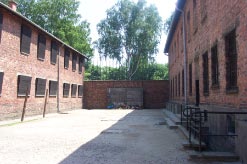
Auschwitz Wall of Death
|
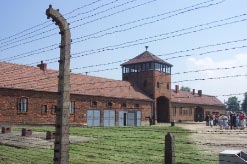
Birkenau |
May 27 (Tuesday) – Krakow
It’s our day to do Krakow. After breakfast, we walked to the main square – too early for the museums. We stopped at the Internet café and exchanged some more money. Then we walked to the Church of St. Peter and St. Paul and another church next door, built in 1200-something (does it really matter?) I think it’s the oldest church in Krakow. Lots of tall statues line the front wall – sort of like the ones in Vatican City. A little old Polish lady was working in the church courtyard. She rushed in to charge us for going into the crypt, but since we didn’t know who was buried there, we passed.
After we knocked off the churches, we went to Wavel Castle, arriving right at 9:30, opening time. They only allow so many tickets at a time, so we wanted to get there early. Again, there are school kids everywhere. We bought tickets for several attractions. Great place, love the great castle wall, huge buildings, typical statue of the guy on a horse guarding the entrance.
First stop on the castle ground was a most amazing church. We saw the casket of a cool knight with a lion sleeping at his feet. Then we saw a casket of some king. The whole place was the most beautifully kept church anywhere – but we had to rush to get to the staterooms at the stated time.
Luckily, at the staterooms we were able to tag along with an English-speaking tour group. Later, in the afternoon we had the same tour guide take us through the private chambers (in the same palace). Here’s what I remember about the place –
· The first room we entered was the banking room with shelves of wooden boxes used to hold money. The money was used to pay the bills – musicians, traveling expenses, and gifts.
· The castle was noted for it’s valuable collection of tapestries – a total of 136 from an early Belgium (Flemish) maker. The tapestries survived WWII by being transferred from one country to another – just before the bombs hit. At one point, the tapestries traveled from England to Canada where they stayed safely before they were returned. The tapestries displayed lots of animal hunting scenes with most of the animals attacking each other. There were also tapestries depicting Bible stores – a series for Adam and Eve in the Garden of Eden, with their two famous sons, Cane and Able. The complete collection of tapestries would never be displayed all at once. The king saved the special ones for special occasions. The function of the tapestries was to keep the chilly castle rooms warmer.
· Each room had large decorative enamel heaters, placed by the windows so that the servants could load them up with coal from outside the room.
· We saw lots of paintings and sculptures of Madonna and child. One was especially nice – Mary looked like she was from Venice (a lovely Renaissance piece).
· There were vases, bowls, etc. that looked like china – only they were made of pottery. China was too expensive, so these were nice imitations fit for a king.
· We loved the way the palace was fitted out – gave us a good feeling of how the royalty really lived. There were lots of rugs and lots of beautifully carved chairs and tables. Lots of carved chests covered with fantastic paintings that were used to store clothes and also to be used as a dowry.
· Some of the walls were covered with wallpaper pressed out of leather.
· We loved the fresco paintings at the top of the walls and the elaborate ceilings. One ceiling had about 20 carved heads looking down at you. One of the heads was a woman with a gag over her mouth because she kept interrupting the king.
· We saw the elevator doors where guests would arrive. Their horses would be left outside while they rode the lift into the main state quarters. There were about 75 elevators in the palace. The outside of each elevator was different and beautifully sculpted by one artist – amazing.
Our eyeballs were loaded with visions of treasures from the past. It was a welcome relief to see a group of about 20 little kindergarteners sitting on the flood drawing pictures of kings, queens, knights, and castles. So precious.
At one point, the king decided to move to Warsaw, leaving Krakow as the royal getaway and thus diminishing the importance of Krakow. We did see the getaway quarters of the last king (or was it the president by then – in 1918). He had a nice big bed, lots of winged comfy chairs, and a funny looking phone by his bed. We also got to peak in at his bathroom with a big, step-down tub.
After the stateroom and private quarters, we viewed the Treasury and Armory – rooms and rooms of weapons and body protection for the knights and their horses. Among the weapons were jousting sticks, knives, swords, guns, canons, rifles, and rifle/sword combinations. What stuck me was all the artwork and carvings that were part of the weapons – Truly a case of form over function. Most of the knights’ Armour had private part protection, nose protection and interestingly enough, little heart cutouts for the ears. Most shoes were pointed. I guess to kick your opponent, if necessary. Everything weighted so much and even the poor horses were loaded down with all that stuff. We did see some vestments and a coronation robe given by Louis IV to the king. (I’m sure they were related. Everyone was politically connected through marriage. Bush better marry off of those twins to a French leader and fast.)
At 11:00, we left the castle for the Jewish section of town called Kazimierz. The place was run down, but making a nice comeback. We saw a few synagogues from the outside – none were open. What do you expect? Before WWII over 160,000 Jews lived in Krakow, now only a hundred. We passed by a restaurant with beautiful music coming from it. It reminded us of the place in the movie, “The Pianist” (which was filmed in Warsaw). So inviting . . .
We had matzo ball soup and a salad at a nice outdoor café called the Ariel. One tour book raved about it – another book detested it. We enjoyed ourselves. Food was good and the weather, fantastic.
After lunch and a look at the Jewish Quarter, we went back to the castle (Castle Wavel) to do the private quarters in the palace. (See description above.) Then we walked along the castle wall.
We walked back to our hotel through a market and found some Wedel candy to take back home. Wedel has been in business in Poland for over 400 years. The candy was recommended by Viola, the beautiful young Polish / American graduate student we met on the train to Krakow.
We spent a couple of hours taking care of business – finding out how to get to the Salt Mines, how to get to Zakopane, where to stay in Zakopane, where to store our luggage, how to use the phone card (have to tear off a corner – who would have thought . . .)
We came back to our room about 5 o’clock, exhausted. We were going to trek back to the Jewish Quarter to a recommended restaurant. I wanted a little snack before walking another couple of miles. On our dresser was a coupon from our hotel restaurant for a little something from a 17th century recipe, so why not? I had to convince Bill – but it was free – say no more. We were off.
The only way to get to the restaurant is by running through the elevator when it’s on the ground floor, then pushing open a heavy door that leads to the cellar. The place is clean, but weird. The restaurant is decorated as an old library of Magellan. There’s a creepy manikin dressed as Magellan sitting at the entry table. Of course we were the only ones in the place. We gave the waitress our coupon for the 17th century snack. She couldn’t speak English and it was obvious she didn’t know anything about this little coupon. She went into the kitchen and returned after about five minutes, motioning for us to come in and sit down. We waited and waited. I begin looking through the books in the fake library – a few were in English. I found a cool Soviet Union Math book for little kids that was translated into English. The title was “Maths and Mummy.” Bill and I were entertained by the book, but were trapped in this cellar. Finally, the waitress came with some bread, then a huge bowl of white borsch with lots of pork and kielbasa sausage. It tasted out of this world.
We were so full after our 17th century snack, we didn’t have to dash to the Jewish Quarter for dinner. Instead, we strolled to the main square and had an expensive desert at an elegant little café right on the square. Afterwards, we phoned Amy using up the rest of our phone card. It was so good to hear her voice – not long now.
Back at the hotel, I discovered the memory card in my camera was full. I’ve taken almost 900 photos – OOPS. I think the memory card in my brain is also full with so many sights, sounds, and data to store and retrieve.
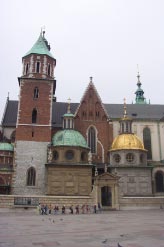
Wavel Castle
|
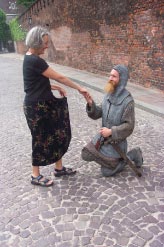
Nancy and her Gallent Knight |
May 28 (Wednesday) – Krakow to the Salt Mines (Wieliczka)
We woke up and saw a big fire from our window. We had our breakfast and took a couple of rolls and cheese from the breakfast buffet for our lunch.
We rolled our suitcases down to the railroad storage. Good-bye to Krakow. Good-bye to that wonderful funky hotel called Jordan with the pictures of San Diego, L.A., San Francisco in the lobby. Good-bye to the strange elevator and goofy little cellar restaurant.
At 9 am we got on a mini bus to the Salt Mines, Wieliczka, 17 km southeast of Krakow. The salt mines are now eerie pits and chambers displaying everything you can imagine carved out of salt -- statues, chandeliers. It’s a major tourist attraction.
We got to the town, bought our tickets for the 10 am English-speaking tour and then walked into the lovely little town square. We returned in time to queue up for the 10 o’clock tour. The place is packed!
A crusty old retired fourth-generation-miner with the driest sense of humor was our guide. He reminded us of our neighbor, Joe. Everything he said was so funny. A bell would ring and he’d say, “Sorry, it’s my coffee break.” When the small electric model with the horses didn’t work, he said, “I’m so sorry. I love to watch the horses go ‘round.” He invited us to lick the walls and said each of us could take 25 grams of salt away. He was the main entertainment. Now for some of the facts I gather about the mine.
· It started in Medieval times. Table salt was mined from the water. Block salt for manufacture, for roads, etc.
· The mine was given as a wedding present from the king to his daughter. One statue portrays the daughter and the king.
· Most of the statues were done by the miners’ themselves over the years. And there were lots of statues – seven dwarfs (but no Sleeping Beauty), Knights, Princess who got the mine, national heroes a ghost of a scary dead miner, the current Pope, etc.
· One room was amazing – about the size of a football field. It had huge chandeliers, alters, carvings of the last supper, Mary and Joseph statues, and other biblical depictions, all carved from salt.
· Horses were lifted down into a shaft to work and stayed there forever.
· Whenever a miner died in an accident, the area was decorated with religious ornaments – Mary, Jesus, etc.
· No mining is done today. They make way too much money as a tourist attraction. It was well worth the visit, in spite of waiting for the cable cars to carry us up with all those school kids. They are everywhere. They screamed each time the car lifted them into the dark shaft.
It was a crazy place. The bottom level of the mine now houses a dance hall (for polkas), several cafeterias and lots and lots of gift shops.
We caught the minibus back to Krakow (30 minute ride). We ate the cheese and rolls we smuggled from our breakfast. We arrived back at the railroad station and retrieved only one of our pieces of luggage, pre-packed for our two-night stay in Zakopane – a little mountain resort in the Tatra Mountains (border of Poland and Slovakia).
We walked to the public bus station and caught the 1:30 pm bus to Zakopane. It took 2 hours and 45 minutes and cost $1.50 each – cheap transportation and the scenery was beautiful as we entered the foothills of the Tatra Mountains. There were farm scenes, cows, haystacks, families working their land and oh, so green. It must rain a lot here, but we wouldn’t know it.
We arrived in Zakopaone about 5:00PM and headed to the Tourist Office, but missed it and went all the way into town, then we had to turn around and backtrack 15 minutes (dragging our luggage). Finally, back at the Tourist Office, we find a totally useless gal, not at all like the glowing reviews of the place described in Lonely Planet. She couldn’t make reservations or even suggestions for hotels, couldn’t make phone calls, couldn’t do this or that … So we turned around again and rolled our suitcases back into town.
We found a beautiful old hotel (1897) right in the heart of town called Sabala. The people at the desk said they couldn’t book us for a 2-night stay. We were both tired and hungry and grumpy, so I suggested that we sit in the lobby to figure out Plan B before we hit the streets again. As we were thumbing through Lonely Planet, the receptionist came over to us and said she had done some rearranging and we could stay for 2 nights. The price was a little high (225 Zloty, about $75) but that included breakfast, welcome drinks, and 10% off meals. I immediately asked if we could please have our welcome drinks NOW!
We were happy travelers again – a comfy, classy place – rustic lightwood on the walls. However, there is always something quirky about these Polish places. The light switch to the bathroom is hidden behind a mirror. You have to move the mirror in order to turn on the lights and one of the Room Services listed in the hotel information guide is “Funny Time.”
We put our things away and went for our welcome drink served on the second floor deck overlooking the main street. The town is packed with school kids of all ages on end-of-the-school-year field trips. We also noticed a lot of characters – a white Madonna posed in a statue position, an Abominable Snowman and a lecherous guy dressed up in an old mountaineering outfit carrying the sweetest little St. Bernard puppy. All the young schoolgirls wanted to pet the little puppy while the guy wanted to pet the schoolgirls. They were taking pictures of each other hugging the puppy with the old lech hugging the girls with a huge grin on his face. The dirty old guy would leave his hand on the schoolgirls’ delicate waists long after the photo was snapped. We also saw a whole slew of little girls dressed in white going to what appeared to be their first communion. In fact, we see lots of nuns and priests all over Poland. I forgot about them. All these sights free from our hotel balcony with our free welcome drinks!
After our drinks, we joined the crowds on the streets. We walked around the town and then came back to the hotel for our dinner. It was great. I had lamb stew and Bill had pierogi (dumplings with meat inside). The restaurant was wonderful, but the band was terrible. About 8 guys, most had string instruments and very loud voices. Luckily they took a lot of breaks (and tuned their instruments a lot). For dessert we had a wonderful piece of pound cake (on the house).
Checked the Internet after dinner – nothing noteworthy. We went back to the room where Bill did our last wash and I tried to catch up on the journal.
Note: BBC is running program after program on “Where are the weapons of mass destruction.” We’re glad someone somewhere wants to hold someone accountable for that unjust Bush war.
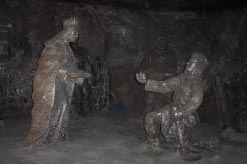
Salt Mine
|
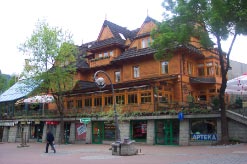
Sabala Hotel, Zakopane |
May 29 – Thursday, Zakopane
We had the BEST breakfast of the trip (at our hotel). We even had freshly cooked omelets. We ate like pigs (and took a little bread, cheese and ham for sandwiches later that day).
We bought a map of the mountains, then walked about 2 miles to catch the lift to the top of the mountains. We got there about 9:45. There were lines of school kids everywhere. It took over 2 hours waiting in line to ride the tram to the top of the mountain. It was windy and chilly at the top, so we went to the café and ordered a little soup and had our sandwich (from breakfast). About 12:30 we began our trek down – fabulous hike with unbelievable views. A lot of the hike was on the high mountain ridge that forms the border between Poland and Slovakia. Coming down the mountains we crossed a few snowfields. We noticed that the trail looked a lot like old Roman roads. The landscape was so dramatic, mountains above, crystal reflective lakes below. It was a “hills alive with the sound of music” type of hike or a walk with Heidi and her grandfather. It was one of the loveliest days we had on the trip. At first it looked like it might rain. The clouds hugged the tops of the mountains. Finally the sun broke through to add to the drama.
Half way down the trail we stopped at an old stone lodge built in the 1920’s for a beer. We continued on down the trail on more ridges and then into a forest. Finally we were back where we started near the lift line. The trails were very well marked – color coded and maintained plus a great map with established arrival times included.
We got back down about 5:30 and caught a mini bus back to town. (Cost about 4 Zt each or $1.25.) Rested in our hotel room – watched a TV program called “Dismissed,” just like “Elimidate.” Silly, but reminded me of home.
Later we went for a walk in the town. I took a picture of the Abominable Snowman talking to Madonna the Statue. The big ole ugly snowman chased me down to collect a Zt, but I escaped into my hotel.
We had a great grilled fish dinner at a place called Czarny Staw just down the block from our hotel. After dinner we checked our e-mail. Got a message from Amy – invited us to Sunday dinner – so good to hear from home. Back to the hotel to more programs on “Where are the damn weapons of mass destruction?”
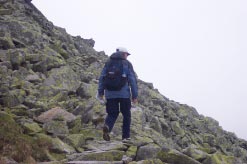
Bill Hiking in the Tatra Mountains
|
Nancy Resting by a Snowfield |
May 30 – Friday, Zakopane
We had another great breakfast at the hotel and then waddled up the hill to catch the funicular (filled with school kids) to go the top of the mountain. It was an absolutely beautiful day – sunny, crisp mountain air.
We got off the funicular at the top of the mountain. We walked along the road passing a lot of commercial stuff—kids rides, animals, beer, hot dogs etc. The place was filled with groups of noisy school kids and some traffic. We finally got to the trail and off the road. (Hike color coded in “blue.”) Part of the trail went through forests, under the ski lifts and through a village where people were going on with everyday life – a woman hanging out clothes, kids playing. The scariest part was when 5 huge Doberman Pinchers ran at us barking. Thank heaves the fence held.
We walked back to town and back to crowds of school kids. I was looking for a bigger shawl for Amy and another present for Zi. It’s not easy shopping in Poland. Everyone is so laid back. The vendors seem annoyed with potential customers. I did buy a little tablecloth for the round table in our living room. Bill was looking for a money exchanger that would give the best rate. He gets so annoyed with shopping.
We went back to our room. I showered and then packed. We left the suitcase at the hotel. We paid our bill and had an issue over the 10% discount for our dinner. We finally got it worked out. The desk clerk handed us back some cash.
Lunchtime – I got a hamburger and Bill got a hotdog and then we checked our e-mail again – Nothing. We walked around town and over to the bus station. Bad timing – a 30-minute wait so I went across the street to get a beer, Bill didn’t want one. The bus was loading before I finished, so I had the beer to go in a plastic cup. I was a happy camper on the bus, relaxed, snoozing. I only woke up when the bus driver stopped and honked to avoid a crash with an angry woman. Please not another bus wreck! The trip was much faster coming back to Krakow, all downhill.
We arrived in Krakow, checked our bag at the train station and went back to the main square. Bill had a beer. I only wanted water. We got ripped off. Beer was 132 zt, the most expensive yet. There were three or more tables of deaf people using sign language.
After our beer, we checked out a restaurant recommended by Lonely Planet, but it was closed. Went back to our favorite place – big mistake. This time the food was just mediocre. The pork steak was really gristly. Oh well. Then we walked back to the Internet café (no news) and around town. There was a massive army of police, security guards and secret service (with their sunglasses and ear phones) near the castle area. A young girl told us that President Bush will be in town tonight. Just our luck! I did notice the American and Polish flags at several hotels. The place is crawling with security and barricades.
We bought an ice cream and got some rolls for breakfast. We walked back to the main square to watch the crowds and listen once again to the strange taps played by a bugler every hour from a church tower window. The tune always stops abruptly. Rumor has it that the medieval bugler was shot in the throat by an arrow on that very note. More research says that an American traveler in the 1920’s made up the whole story.
About 9 pm, we headed back to the railroad station. We claimed our luggage and found platform 1 and waited for the night train to Budapest. We got on the train at 10:40 pm, got settled into our little compartment. The Passport Agents woke us up twice during the night – once when we crossed into Slovakia (about 2:30) and then an hour or so later when we crossed into Hungry. The agents flashed their lights into our eyes checking to see if we were the ones on the passport photos. Other than that, the train ride lulled us in a very peaceful sleep.
Zakopane
|
Hills Above Zakopane |
May 31 – Saturday (Budapest)
We got up, managed to brush our teeth, shave, get make up on and eat the breakfast (somewhat squished) we bought in Krakow the night before.
We got to Budapest about 9:30. Steve, the owner of the apartment we had arranged for our last night in Budapest, met us at the Train Station. He was sweet, but a real nerd – Engineer type. The apartment he took us to in Budapest was depressing. A picture of a Doberman Pincher hangs over the bed – Good Lord. We paid him the 48 Euros and he was off.
We took a bath and then went to the Metro. We caught a train to go to a little town on the Danube Bend, called Szentendre (19 km north of Budapest). There were seven churches in town and an old market square right out of medieval times. There were a lot of art museums. I didn’t know that Bill only got a little money changed – so we didn’t have much money for museum hopping or shopping – and the town was loaded with shops. We had a quick bite at a funky placed called Dixie Chicken – deep-fried chicken patty, cheap and American. We walked down and saw the Danube and then decided, without money, we were sick of this cute town and squares and churches. We caught the train back to Budapest, stopping at an old Roman ruin – Aquincian. It was a very impressive place covering a lot of ground. There were Roman soldiers, bonsai plants and lots of school kids doing crafts. An interesting place – well worth the stop. We were hot and tired when we got back on the crowded train to go to Budapest Battyany station.
We came up from the underground found we were right across from Parliament. We had a beer at the Anglical, a café next to the big church, on the square. Then we got back on the metro and went back for pasta at our favorite place, Soul Café. We walked back to our apartment, remembering the old haunts. We stopped for an ice cream. We came back to the apartment and took a bath. What a scary place -- water bubbles coming up from everywhere. We packed, had a good night’s sleep, and got an early cab ride to the airport for our flight home.
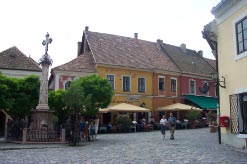
Szentendre
|
Aquincian Roman Ruin |
|